Litter-Robot 4 Review (2026): The Automatic Litter Box That Actually Works
Up to 4 cats
Automatic, post-use
Whisker app (iOS/Android)
24.25 x 27 x 29.5 in
Quick answer
The Litter-Robot 4 is a self-cleaning litter box that cycles automatically after every use, dropping clumps into a sealed, carbon-filtered waste drawer. It is designed for households of up to four cats and connects to the Whisker app on iOS and Android for per-cat usage and weight tracking. The unit measures 24.25 x 27 x 29.5 inches, carries an 18-month warranty, and its weight sensors require cats of at least 3 lbs.
Methodology & sources
TestedThis review is backed by a validated long-term test record retained by Sofia Marsh.
Verified on August 8, 2026
Pros
- Self-cleaning after every use
- Odor control is excellent with carbon filter
- App tracks usage and weight per cat
- Large waste drawer lasts days for multi-cat homes
Cons
- High upfront cost
- Requires premium clumping litter
Best for
- Multi-cat households
- Busy owners who travel
- People sensitive to litter box odors
Setup and first impressions
When the Litter-Robot 4 arrives at your doorstep, the first thing you will notice is the sheer size of the shipping box. It is monolithic. Unboxing it requires a fair amount of floor space and ideally two people, though a single determined person can manage it by carefully tipping the box and sliding the unit out.
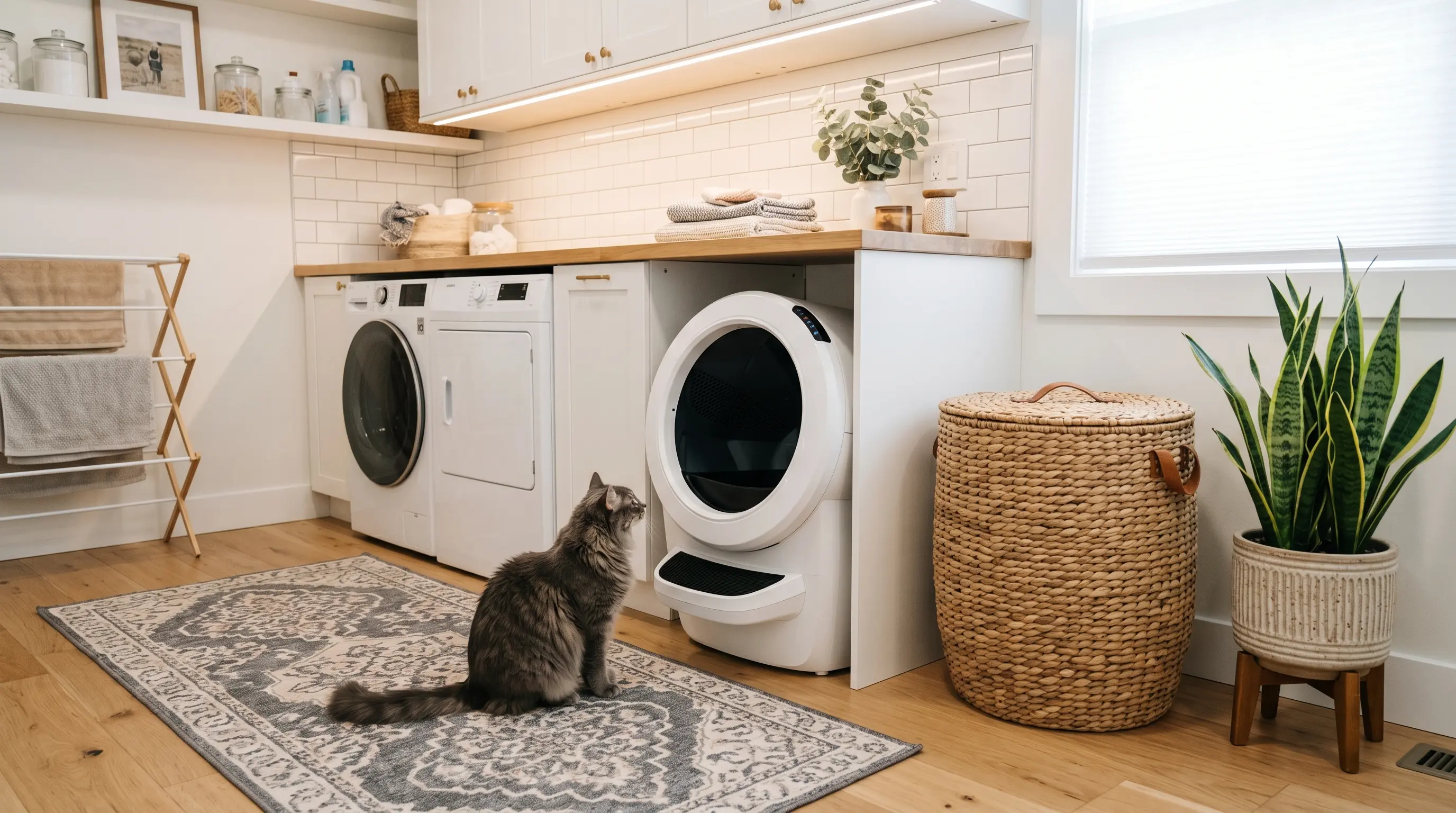
Once liberated from its cardboard housing, the Litter-Robot 4 makes a striking physical impression. Measuring 24.25 x 27 x 29.5 inches, it has a footprint roughly equivalent to a small washing machine or a miniature armchair. You cannot simply tuck this into a tiny half-bathroom next to a toilet; it requires dedicated real estate. However, compared to its predecessor, the Litter-Robot 3, the design is vastly improved. Whisker has traded the bulky, industrial look of a cement mixer for a sleek, matte-finished, futuristic globe. The opening is significantly wider and more inviting, which is a crucial design choice for reducing claustrophobia in larger cats.
Setup is remarkably straightforward. The unit arrives fully assembled. There are no complicated gears to align or tracks to snap together. You simply remove the packing tape, ensure the globe is sitting properly on its base gear, and plug the power adapter into the wall. The machine immediately powers on and performs an initial cycling sequence to calibrate its position and weight sensors.
Connecting the unit to Wi-Fi and pairing it with the Whisker app was a seamless process that took less than five minutes. The app guides you through scanning a QR code on the back of the unit, connecting to your home's 2.4 GHz network, and naming your robot.
Once the cycle begins, the globe rotates, sifting the clean litter into a holding chamber while the clumped waste and solid feces slide along the flexible rubber liner. At the apex of the rotation, a heavy-duty trapdoor opens, and the waste drops into the large drawer located in the base of the unit.
This waste drawer is where the true magic of the odor control happens. It is a tightly sealed compartment. When the globe returns to its home position, the trapdoor is completely blocked by the solid bottom of the globe, essentially creating an airtight seal over the waste drawer. Furthermore, Whisker has integrated a large, replaceable carbon filter that sits directly over the waste drawer vent. This filter actively absorbs and neutralizes the gaseous odors emanating from the accumulated waste.
App and multi-cat tracking
In the era of smart homes, every appliance seems to have an app, and often, they are unnecessary gimmicks. The Whisker app (available on iOS and Android), however, is a fundamental and highly functional component of the Litter-Robot 4 experience. It elevates the machine from a simple automated sifter to a comprehensive feline health and management system.
The core technology driving the app's most impressive features is the OmniSense detection system. Built into the feet of the Litter-Robot 4 are highly precise weight scales, accompanied by a curtain of infrared lasers across the entrance. When a cat steps into the globe, the machine instantly registers their exact weight.
The app presents this data in clean, easy-to-read charts and graphs. You can view daily, weekly, and monthly statistics on how often each specific cat is using the box. While tracking your cat's bathroom habits might sound obsessive, it is actually a vital tool for preventative veterinary care. Cats are notorious for hiding illnesses. Often, the very first sign of a urinary tract infection (UTI), kidney disease, or diabetes is a sudden increase in litter box usage.
Who should buy it
The Litter-Robot 4 is an incredibly specific tool designed to solve a specific set of problems. It is not a universal necessity for every pet owner, but for certain demographics, it is a life-altering convenience.
Multi-cat households are the primary beneficiaries of this machine. If you have two, three, or up to four cats, the sheer volume of waste generated daily can feel overwhelming. The Litter-Robot 4 handles this volume with ease. Because the machine cleans itself after every single use, the fourth cat to use the box experiences the exact same pristine bed of litter as the first cat. This virtually eliminates territorial disputes over dirty litter boxes and prevents the behavioral issue of cats eliminating outside the box because it isn't clean enough to their standards. The large waste drawer means you are emptying a bag twice a week instead of scooping multiple boxes twice a day.
Busy owners who travel frequently will also find immense value here. Whether you work long 12-hour shifts, take frequent weekend trips, or simply have a chaotic schedule, the Litter-Robot 4 ensures your cats are never subjected to a filthy bathroom. Paired with an automatic feeder and water fountain, it allows for safe, clean, short-term absences without needing to hire a pet sitter just to scoop poop. The app connectivity provides peace of mind, allowing you to verify from anywhere in the world that the machine is cycling and your cats are using it normally.
Finally, people sensitive to litter box odors or those living in smaller, open-concept spaces should strongly consider this investment. If your living arrangement forces you to place the litter box in a high-traffic area like a kitchen, living room, or home office, the advanced odor control provided by the immediate cycling and the carbon-filtered, sealed waste drawer is worth its weight in gold. It allows you to reclaim the air quality of your home without banishing your cats.
Who should skip it
Despite its brilliance, the Litter-Robot 4 is not for everyone, and there are several scenarios where it would be an inappropriate or frustrating purchase.
Owners of kittens or very small cats must also skip the automated features of this box. The OmniSense weight sensors require a minimum weight of 3 lbs to reliably detect a cat's presence. If a kitten weighing under 3 lbs enters the box, the machine will not know they are there. This means it will not trigger the automatic cleaning cycle post-use. While the laser curtain acts as a safety backup to stop the globe if it is already moving, Whisker explicitly states that the machine must be kept in "manual mode" (powered off, and only cycled by pressing the button while you are physically watching) until the kitten reaches the 3 lb threshold.
Additionally, people who strictly use alternative litters like pine pellets, newspaper pellets, or large-crystal silica will find the Litter-Robot 4 incompatible with their lifestyle. The internal sifting screen relies on the physical properties of heavy, granular clumping litter. Pine pellets will not fit through the screen, resulting in all the clean pellets being dumped into the waste drawer alongside the feces. If you or your cat absolutely refuse to use clumping clay or natural clumping alternatives (like clumping corn or cassava), this machine will not work for you.
How it compares
To truly understand the value of the Litter-Robot 4, it is helpful to see how it stacks up against the broader market of automatic litter boxes.
Litter-Robot 4 vs. Litter-Robot 3 Connect The most common comparison is against Whisker's own predecessor, the Litter-Robot 3 Connect. Having used both, the differences are stark. The LR4 is significantly quieter; the LR3 has a distinct mechanical grinding noise that can wake you up at night, whereas the LR4 is practically a whisper. The footprint of the LR4 is sleeker, and the entrance is much wider, making it far more inviting for large cats. The sensors are also vastly upgraded. The LR3 relies on a spring-loaded mechanical weight sensor in the base that is prone to requiring manual recalibration, while the LR4 uses highly accurate digital scales and laser curtains. While the LR3 is cheaper, the LR4 is undeniably a superior, more refined machine in every metric.
Litter-Robot 4 vs. Popur X5 or Leo's Loo Too In recent years, several competitors have adopted the rotating globe or rotating drum design, such as the Leo's Loo Too and the Popur X5. While Leo's Loo Too offers a similar aesthetic and a slightly lower price point, its app ecosystem is nowhere near as robust or reliable as the Whisker app, and its opening is notably smaller. The Popur X5 features an open-top design which some cats prefer, but it takes up an enormous amount of floor space and its waste receptacle is not as effectively sealed against odors as the Litter-Robot 4's carbon-filtered drawer. Whisker's 18-month warranty and established customer service history also give it a distinct edge over newer, less proven brands in the space.
Verdict
On published specifications, the Litter-Robot 4 is a highly engineered appliance built around one idea: automating the least pleasant part of cat ownership. Its documented draw is reliability of the daily cycle rather than novelty — and its documented cost is the premium tier it occupies in the automatic-litter category.
The promise of self-cleaning after every use is delivered flawlessly, ensuring a consistently hygienic environment for your cats. The odor control is genuinely best-in-class, utilizing a smart combination of immediate waste isolation and carbon filtration to keep your home smelling clean, even in a heavy-use, multi-cat household. Furthermore, the Whisker app elevates the machine from a convenience item to a vital health monitoring tool, offering weight and usage tracking that can alert you to medical issues before they become critical.
Editorial summary
The Litter-Robot 4 is a self-cleaning litter box for up to four cats, with a sealed carbon-filtered waste drawer and Whisker app tracking of usage and weight.
Where to buy
Check the merchant for the current price and availability. We may earn a commission.