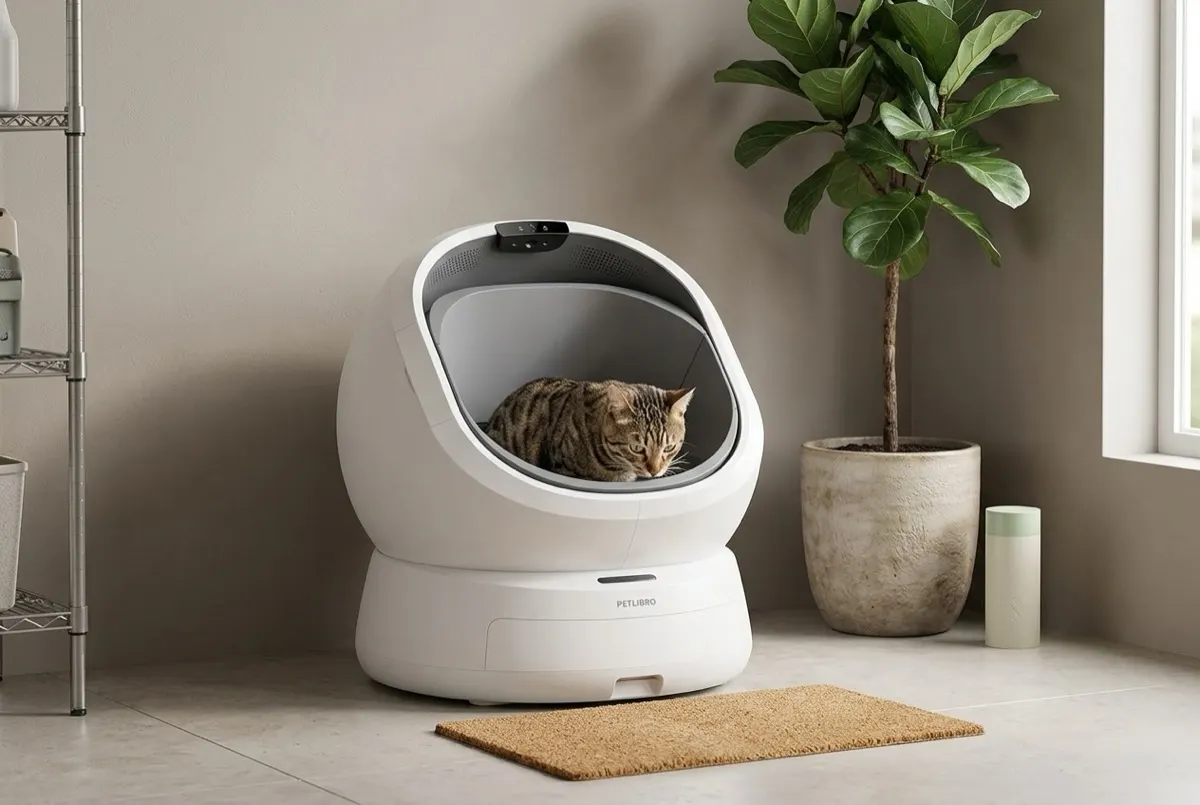
PETLIBRO Luma Review (2026): A Litter Box That Watches the Litter Box
Open-top self-cleaning
11L / 2.9 gal
2.2 to 22 lb
Up to 10 cats
Quick answer
The PETLIBRO Luma is an open-top self-cleaning litter box with an 11L sealed waste bin and an overhead camera that records each visit for AI waste analysis. It suits cats from 2.2 to 22 lb, recognises up to ten cats individually, and controls odour with continuous airflow adjustable in the app. It requires clumping litter and a 2.4GHz Wi-Fi connection for its monitoring features.
Methodology & sources
TestedThis review is backed by a validated long-term test record retained by Sofia Marsh.
Verified on August 8, 2026
Pros
- AI camera separates urine from stool and solid from loose waste
- Recognises up to 10 cats and logs visits by name
- Triple safety sensors pause the cycle when a cat is present
- Large open-top entry suits nervous or larger cats
Cons
- Large open-top footprint needs dedicated floor space
- Camera health features depend on the app and a stable connection
- Clumping litter only, which rules out crystal or pellet systems
Best for
- Multi-cat households that need per-cat usage logs
- Owners who want early visibility into litter-box habits
- People who travel and need several days of hands-off capacity
Spec comparison
| Spec comparison | PETLIBRO Luma Automatic Litter Box | PETKIT PuraMax 2 | PETKIT Purobot Max Pro 2 |
|---|---|---|---|
| Type | Open-top self-cleaning litter box | — | — |
| Waste bin capacity | 11L / 2.9 gal | — | — |
| Cat weight range | 2.2 to 22 lb | 3.3 to 22 lb (1.5 to 10 kg) | 3.3 to 22 lb (1.5 to 10 kg) |
| Multi-cat recognition | Up to 10 cats by name | — | — |
| Camera | Built-in with AI waste analysis | — | 1080p HD, 210-degree wide-angle lens, IPX5 |
| Safety sensors | Visual, weight, and infrared motion | 11 (infrared and weight) | 12 with patented anti-pinch design |
| Odor control | 24/7 active airflow | N50 2.0 deodorant, optional smart air spray | Sealed bin, N50 deodorant and N60 air refresh |
| Litter compatibility | Clumping litter | — | — |
| Connectivity | PETLIBRO app (2.4GHz Wi-Fi) | — | — |
| Power | Corded; adapter input 110-240V AC, output 12V/5A DC | 12V/2A DC adapter (rated input) | 12V/2A DC adapter (rated input) |
| Warranty | 24-month warranty | 1-year limited warranty | 1-year limited warranty |
| Dimensions | 23.3 x 22.5 x 28.1 in (59.2 x 57.3 x 71.4 cm) | 24.41 x 21.18 x 21.73 in (620 x 538 x 552 mm) | 25.86 x 21.18 x 23.74 in (657 x 538 x 603 mm) |
| Drum capacity | — | 76 L | 76 L |
| Waste bin | — | 7 L sealed, up to ~15 days for one cat | 8 L sealed, up to ~17 days for one cat |
| Entrance height | — | 7.87 in low entry | — |
| WiFi | — | 2.4GHz only | 2.4 and 5GHz |
| Litter | — | Clumping only, no crystal | Clumping clay, tofu, or mixed; granules to half an inch |
| App required? | — | Yes for settings and tracking; runs preset cycles if the network drops | Settings, camera, and tracking managed in the PETKIT app |
| AI recognition | — | — | Cat facial recognition plus weight, up to 15 cats |
| Entrance opening | — | — | 10.51 x 10.74 in, 43 percent larger than prior gen |
| Noise | — | — | Around 35 dB |
Most automatic litter boxes solve exactly one problem: the scooping. They wait for a cat to leave, rake or rotate the clumps into a sealed drawer, and reset. That is genuinely useful, and for years it was the whole pitch. The PETLIBRO Luma tries to move the category somewhere else. It still does the scooping, but its headline feature is a built-in camera and an AI layer that watches what actually happens inside the box and turns each visit into data you can read on your phone.
That shift matters because a litter box is one of the few places a cat leaves a daily, unfiltered record of its health. Changes in frequency, straining, or the balance between solid and loose waste are classic early warning signs for urinary and digestive problems. A cat will hide illness for as long as it can; the litter tray will not. The Luma is built around that idea, and whether it is right for you comes down to how much you value that monitoring versus the space and setup it asks for.
What sets the Luma apart
Strip away the marketing and there are three things the Luma does that a conventional self-cleaning box does not. It records each visit on video, it runs AI analysis on what it sees to categorise the waste, and it recognises which cat used the box so it can attribute every session to the right animal. PETLIBRO packages these under the idea of habit tracking, but the practical outcome is a timeline in the app that shows who went, when, for how long, and roughly what came out.
The rest of the hardware is competent rather than revolutionary. It is an open-top design rather than the enclosed globe or dome format used by several rivals, and it leans on airflow rather than a carbon-only cartridge for odour. Those are sensible choices, but they are not the reason to pick this box over a cheaper automatic model. The camera and the analytics are.
Design and the open-top format
The Luma uses a large, open-top tray rather than a hooded chamber. That decision cuts both ways. On the positive side, an open entry is far less intimidating for cats that dislike stepping into an enclosed space, and it accommodates larger animals comfortably. PETLIBRO states the box suits cats from 2.2 to 22 lb, which covers everything from a slim adult to a substantial Maine Coon. Cats that have refused domed automatic boxes in the past often accept an open tray with much less coaxing.
The trade-off is footprint and containment. An open box does nothing to hide the litter bed from view, and it offers less resistance to enthusiastic diggers who kick litter over the rim. It also takes up a meaningful patch of floor. This is not a unit you tuck discreetly behind a door; it needs a dedicated spot with clearance around it, ideally against a wall where the camera has a clean line of sight across the tray.
Build quality is solid. The plastics are thick, the waste bin seats firmly, and the whole assembly feels stable enough that a determined cat cannot rock it. The camera housing sits above the tray looking down, which is the correct angle for the analysis to work and also the reason placement matters so much.
How the self-cleaning cycle works
The cleaning logic follows the familiar pattern. Sensors detect when a cat enters and settle, then detect the exit. After the cat leaves, the box waits a delay you can set in the app so the fresh litter has time to clump, and only then does it run its cleaning cycle to move waste into the sealed bin below. The delay is important: run it too soon and you risk raking un-clumped litter, run it too late and odour lingers.
The waste bin holds 11L, which PETLIBRO frames as roughly seven days of capacity for two cats or up to two weeks for a single cat. Those numbers are a guideline rather than a guarantee, because clump size depends on the cat, the litter, and how much gets kicked out. Still, the practical result is that most households can go several days without touching the box, which is the entire point of buying one.
Because the bin is sealed and recessed, emptying is a contained job rather than a scatter of loose clumps. You lift out the drawer, bag the contents, and reset. It is the least glamorous part of owning any automatic box, and the Luma does not eliminate it; it just spaces it out.
The AI camera and waste analysis
This is the feature that justifies the Luma's name and its price bracket. A camera positioned above the tray records each visit, and PETLIBRO's AI processes the footage to classify what it sees. According to the manufacturer, the system distinguishes urination from defecation and further separates solid stool from loose or abnormal waste. Each visit is captured for up to around ten minutes and stored so you can review it later rather than needing to catch it live.
The value here is trend detection, not diagnosis. One loose stool means little; a pattern of loose stools across several days, or a sudden jump in urination frequency, is the kind of signal that gets a cat to the vet earlier than a casual owner would otherwise notice. For a single-cat home this is convenient. For a multi-cat home, where it is often impossible to know which animal produced what, it can be genuinely revealing.
It is worth being clear-eyed about the limits. AI waste classification is probabilistic, camera angles and litter colour affect accuracy, and the feature depends on the app and a working connection. Treat the analysis as a prompt to look more closely, never as a verdict. PETLIBRO itself frames the data as a monitoring aid, and its own guidance points owners to a veterinarian whenever behaviour or health changes.
Multi-cat recognition and health tracking
Alongside the waste analysis, the Luma recognises individual cats and logs their visits by name. PETLIBRO states it can distinguish up to ten cats from any angle, which is more than almost any household needs but signals how the recognition is meant to scale. In practice, the standout benefit is for homes with two, three, or four cats where litter habits have always been an anonymous blur.
Once each cat is set up in the app, the visit timeline attributes every session to a specific animal, and the app builds a per-cat history of frequency and duration. If one cat starts visiting far more often, or stops visiting for a worrying stretch, the pattern surfaces against that individual rather than being averaged away across the group. That is a real diagnostic advantage that no manual box and no non-camera automatic box can match.
Recognition is not flawless. Cats of very similar colour and size can occasionally be confused, and a new cat needs a setup period before the system reliably tells it apart. But as a way of turning a shared box into per-cat data, it does the job the category has never done before.
Safety sensors
Any box that moves under its own power around a live animal has to prove it is safe, and the Luma layers three independent detection methods to do so. PETLIBRO describes a combination of visual, weight, and infrared motion sensing that together determine whether a cat is inside. If any of them detects a cat, the cleaning cycle will not start, and a cycle already counting down will pause.
Three overlapping sensors is a more conservative design than the single weight-plate approach used by some cheaper units, and the redundancy is reassuring for households with curious kittens or cats that like to re-enter the box moments after leaving. As with any automated appliance, the manufacturer's setup and safety instructions should be read before first use, particularly around the minimum cat weight, since very small kittens under 2.2 lb may not register reliably.
Odour control and maintenance
The Luma controls smell with continuous airflow rather than relying solely on a replaceable carbon pod. PETLIBRO runs the fan around the clock and lets you adjust its speed from the app, and the company cites capture of the large majority of residual odour. Active airflow has a practical edge over passive cartridges because it keeps working between cleaning cycles rather than only masking smell after the fact, and adjustable speed lets you trade a little noise for stronger extraction in a small room.
Maintenance beyond emptying the bin is the usual routine for a self-cleaning box: periodic wipe-downs of the tray, occasional deeper cleaning, and keeping the camera lens clear so the analysis stays accurate. A smeared or dusty lens is the quickest way to degrade the feature you paid for, so it belongs on the cleaning checklist. The app issues reminders that help keep this on schedule.
The PETLIBRO app
Everything that makes the Luma special lives in the app: the live stream, the recorded visits, the waste analysis, the per-cat logs, the fan control, and the cleaning-delay settings. That is a strength when it works and a dependency to weigh before buying. The unit connects over 2.4GHz Wi-Fi, so it needs reasonable signal wherever the box lives, which is often a bathroom or utility area where coverage can be weakest.
The app experience is central enough that anyone who dislikes app-driven appliances, or who has an unreliable home network, should factor that in. Strip away the connectivity and the Luma still cleans, but the monitoring that distinguishes it from a mid-priced automatic box goes quiet.
Litter and setup considerations
The Luma is designed around clumping litter. That is standard for camera-and-rake style boxes, but it rules the unit out for anyone committed to crystal or pellet systems, so confirm your preferred litter is compatible before buying. Clumping litter also means the cleaning-delay setting matters: give clumps enough time to firm up and the cycle stays clean and low-maintenance.
Initial setup asks for a little patience. Cats need time to accept a new box, the recognition system needs a learning period to tell individuals apart, and the cleaning delay usually benefits from a tweak or two once you see how your litter behaves. None of this is difficult, but the Luma rewards a careful first week rather than a plug-and-forget installation.
Noise and placement
Placement is more consequential for the Luma than for a basic automatic box, because the camera dictates where it can live. The unit needs a spot where the overhead lens looks cleanly across the tray, which usually means against a wall with clearance on the open side and nothing overhanging the top. It also needs to sit within reliable 2.4GHz Wi-Fi range, which in many homes is the hardest constraint, since litter boxes tend to end up in bathrooms, basements, and utility rooms where signal is weakest.
Noise is reasonable rather than silent. The cleaning cycle produces the mechanical sound common to every self-cleaning box as it moves waste into the sealed drawer, and the odour-control fan adds a low, continuous hum that scales with the speed you set. Neither is loud enough to be a problem in a utility space, but if the only viable spot is next to a bedroom, run the fan at a lower speed and expect to hear the cleaning cycle when it fires. Cats generally habituate to the cycle noise quickly, especially since it only runs after they have already left the box.
How it compares to enclosed boxes
Against the enclosed globe and dome designs that dominate the automatic category, the Luma makes a deliberate set of trade-offs. Enclosed boxes contain litter scatter better, hide the waste from view, and often present a smaller floor footprint for the same internal volume. What they cannot do is see inside themselves. The Luma gives up some containment and a tidier silhouette in exchange for the camera, the AI waste analysis, and the per-cat recognition that no sealed globe can offer.
That is the decision in a sentence. If the goal is the cleanest possible enclosure that simply removes scooping, an enclosed automatic box is the more focused tool. If the goal is turning the litter box into a monitoring device that flags health changes early and attributes them to the right cat, the open-top Luma is doing something the enclosed designs structurally cannot. The right answer depends entirely on which of those problems you are actually trying to solve.
Who should consider it
The Luma makes the most sense for multi-cat households and for owners who actively want visibility into litter habits. If you have two or more cats and have ever wished you knew which one was straining or going too often, the per-cat logging is close to unique at this level. If you travel and need several days of hands-off capacity, the sealed 11L bin delivers it. And if you view a litter box as a health checkpoint rather than a chore to hide, the camera and analysis turn a daily nuisance into a stream of useful signal.
It also suits cats that reject enclosed boxes. The open-top tray and generous weight range make it approachable for larger and more anxious animals that never settled into a domed automatic unit.
Who should look elsewhere
If your priority is simply not scooping, and you do not care about monitoring, a cheaper enclosed automatic box will save you money and floor space while doing the core job. The Luma's premium sits almost entirely on the camera and analytics; paying for them without using them is poor value.
Households with kittens under the stated weight, or owners set on crystal or pellet litter, should look at other designs. And anyone with weak Wi-Fi where the box will live, or a firm dislike of app-dependent hardware, will lose the very features that make this model worth its price.
Verdict
The PETLIBRO Luma is an ambitious attempt to make the litter box the smartest health sensor in the home, and on the strength of its published specifications it largely succeeds at what it sets out to do. The AI waste analysis and per-cat recognition are meaningful additions rather than gimmicks, especially for multi-cat owners who have never had a way to separate one cat's habits from another's. Backed by three-way safety sensing, continuous airflow odour control, and a sealed multi-day bin, the core hardware is competent enough to earn the space it demands.
The caveats are equally clear. This is a large open-top unit that needs room, it commits you to clumping litter, and everything distinctive about it flows through an app and your home network. The monitoring is a prompt to pay attention, not a substitute for a veterinarian. For an owner who wants those insights and has the space to host the box, the Luma offers something the rest of the category still does not. For an owner who just wants to stop scooping, it is more box, and more subscription-style dependence, than the job requires.
Editorial summary
The PETLIBRO Luma is an open-top self-cleaning litter box with an AI camera that analyses waste, recognises up to ten cats, and logs each visit in the app.
Where to buy
Check the merchant for the current price and availability. We may earn a commission.