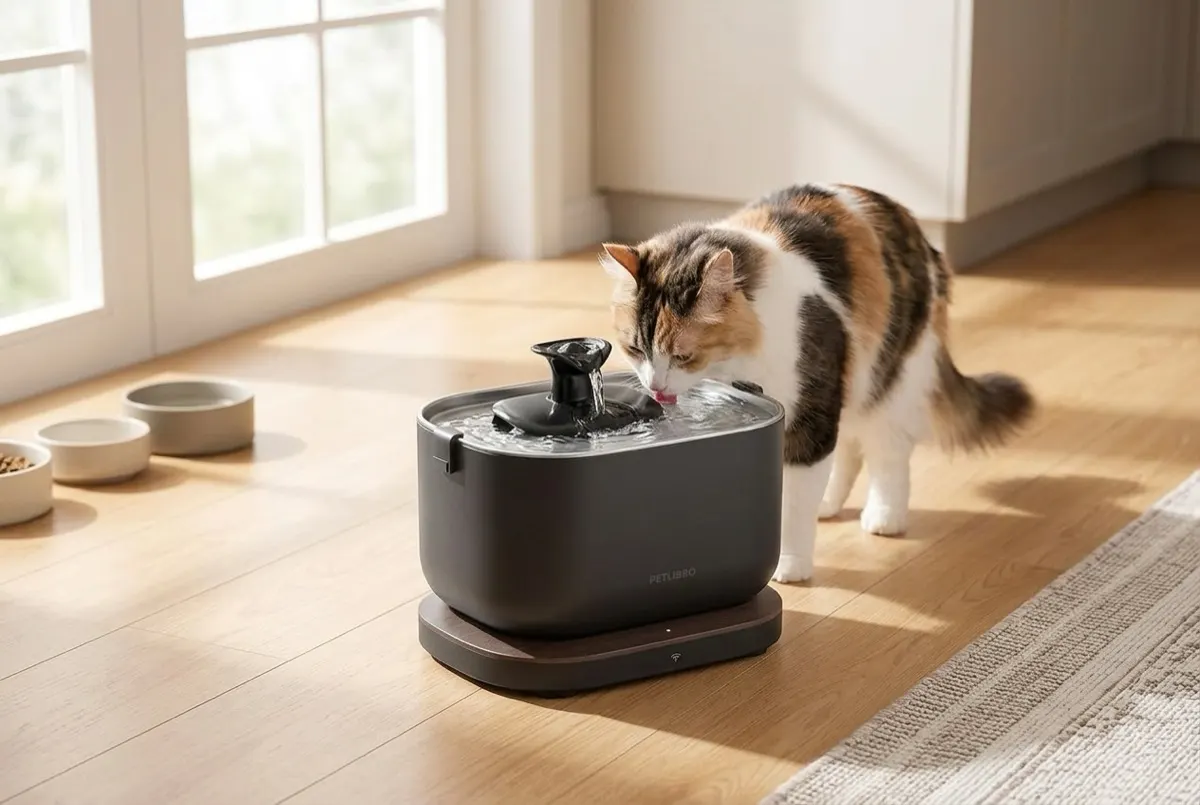
PETLIBRO Dockstream Review: A Smarter Way to Get a Cat to Drink
2.5L / 84oz
304 stainless steel
2.4GHz Wi-Fi
Water-intake logging
Methodology & sources
TestedThis review is backed by a validated long-term test record retained by Sofia Marsh.
Verified on August 8, 2026
Pros
- Wireless pump removes the cord that runs to the water bowl
- App logs how much and how often a pet drinks
- 304 stainless steel tray resists biofilm and cleans easily
- Radar sensor starts the flow only when a pet approaches
Cons
- App intake tracking needs a stable 2.4GHz connection
- Filters and pump are consumables that need replacing
- Battery pump means periodic recharging
Best for
- Cats that drink too little from a still bowl
- Owners who want to track a pet's water intake
- Households that dislike a pump cord in the water
Spec comparison
| Spec comparison | PETLIBRO Dockstream Smart Water Fountain | PETKIT Eversweet 3 Pro Cat Water Fountain | PetSafe Drinkwell Platinum Pet Fountain |
|---|---|---|---|
| Capacity | 2.5L / 84oz | 1.6L / 56oz | 168 oz / 1.3 gal (~5 L) |
| Tray material | 304 stainless steel | — | — |
| Connectivity | 2.4GHz Wi-Fi app monitoring | Bluetooth app; Wi-Fi remote via PETKIT main device | — |
| Intake tracking | PawSense water-consumption logging | — | — |
| Pump | Wireless pump, no external cord | Wireless magnetic-induction pump, no cord in water | Submersible, low-voltage 12 V, ~5.5 ft cord |
| Filtration | 4-layer vertical filter | 4-layer filter with activated carbon and ion-exchange resin | Replaceable activated-carbon filter plus pre-filter |
| Flow modes | Continuous and intermittent | Smart (intermittent), Normal (continuous), Night | — |
| Sensor | Radar induction (flow on approach) | — | — |
| Material safety | BPA-free | — | — |
| Power | AC adapter, 5V/1A DC output | USB 5V/1A, cable included, wall adapter not included | — |
| Warranty | 24-month warranty | 12-month limited manufacturer warranty | 1-year limited warranty (US) |
| Container material | — | SUS 304 stainless steel, BPA-free | — |
| Base | — | ABS plastic, separate from water tank | — |
| Noise | — | Under 25 dB (manufacturer rating) | — |
| Safety | — | Anti-dry-burn automatic pump shutoff | — |
| Dimensions | — | 7.7 x 7.7 x 5.8 in, 3.8 lb | — |
| Reservoir | — | — | Snap-on rear reservoir, gravity-fed |
| Stream | — | — | Patented free-falling stream, adjustable flow |
| Materials | — | — | BPA-free plastic |
| Cleaning | — | — | Top-rack dishwasher safe (pump hand-wash only) |
| Model | — | — | PWW00-13703 |
Cats are famously bad at drinking water, and it is not merely an inconvenience. Descended from desert animals, cats have a naturally low thirst drive and evolved to draw most of their moisture from prey. Dropped into a home and fed dry food from a still bowl, many simply do not drink enough, and chronic under-hydration is directly tied to the urinary and kidney problems that plague the species. Getting a cat to drink more is one of the most useful things an owner can do for its long-term health, and it is exactly the problem a water fountain sets out to solve.
The PETLIBRO Dockstream Smart Water Fountain takes the familiar circulating-fountain idea and adds two things that matter: a cordless pump that removes the fountain's most annoying design flaw, and app-based monitoring that turns a cat's drinking into data an owner can actually see. For a species that hides everything, including how little it drinks, that visibility is a genuinely useful addition to a device that already earns its place by encouraging hydration in the first place.
Why a fountain, and why a smart one
The basic mechanism is behavioural. Cats are instinctively drawn to moving water, a preference rooted in the wild association between running water and freshness, and standing bowls simply do not trigger the same interest. A fountain that keeps water circulating and aerated is more appealing to drink from and stays fresher and better oxygenated than a bowl that sits stagnant between top-ups. For many cats, swapping a still bowl for moving water measurably increases how much they drink, which is the entire point.
A plain fountain does that and nothing more. The case for a smart one rests on the extra layer: knowing how much your cat actually drinks. Because dehydration in cats is both common and quietly dangerous, a fountain that logs intake converts a vague hope that the cat is drinking enough into an actual figure you can watch over time. That combination, encouraging drinking and then measuring it, is what separates the Dockstream from a basic circulating bowl.
The wireless pump
The single best design decision here is the cordless pump. Traditional fountains run a power cable from a wall socket down into the water, and that cord is the source of most fountain frustrations: it dictates placement near an outlet, it is a tripping and chewing hazard, and it complicates cleaning because water and mains cabling have to be kept carefully apart. The Dockstream moves to a wireless pump powered by a rechargeable battery in a base, so no cable ever reaches the water.
The practical payoffs are larger than they first appear. Without a tethering cord, the fountain can go wherever the cat prefers to drink rather than wherever a socket happens to be, which for cats often means well away from the food bowl. Cleaning becomes far simpler because the whole water-carrying assembly lifts away with no cable to route around a sink. And the chewing and tripping risk of a cord in a living space disappears. It is the kind of change that sounds minor on a spec sheet and turns out to shape the entire daily experience.
App monitoring and water intake as a health signal
The connected feature that defines this model is intake monitoring. Over a 2.4GHz Wi-Fi connection, the fountain logs a pet's drinking, PETLIBRO frames this under its PawSense health monitoring, tracking volume, timing, and frequency in the app. For a single-cat household, that turns the most invisible of a cat's daily behaviours into a chart you can read.
The health value is real, with an honest boundary. A sustained drop in drinking can be an early hint of illness, while a marked increase in thirst is itself a classic warning sign for several serious feline conditions, including kidney disease and diabetes. A fountain that quantifies intake gives an owner a chance to notice those shifts earlier than they otherwise would. What it cannot do is interpret them: the app records the trend, but a meaningful change, in either direction, is a reason to consult a veterinarian rather than a diagnosis. In a multi-cat home the figure also blurs, since the fountain measures water leaving the bowl, not which cat drank it, so intake tracking is most precise where a single cat uses it.
Flow modes and the radar sensor
The Dockstream offers more than one way to run the water, which matters because cats are individuals with strong preferences. A continuous-flow mode keeps the water moving constantly, which suits cats that like a steady stream and owners who want maximum aeration. An intermittent mode cycles the flow on and off, which conserves both battery and pump wear while still refreshing the water regularly. Being able to match the mode to the cat, rather than forcing one behaviour, is a quiet but real advantage.
The most interesting option is the radar induction mode. Instead of running on a timer, the fountain uses a sensor to detect when a pet approaches and starts the flow only then, running for a set spell before settling again. This is elegant on several fronts: it saves battery and pump life by not circulating water to an empty room, it reduces noise when no one is drinking, and it still greets the cat with moving water the moment it arrives. For a battery-powered fountain in particular, an approach-activated mode is a smart way to stretch the time between charges without sacrificing the appeal of movement when it counts.
The 304 stainless steel tray
Material choice is where a lot of fountains quietly let cats down, and the Dockstream's 304 food-grade stainless steel tray is the right answer. Plastic fountains and bowls develop biofilm, a slimy bacterial layer, quickly, and they are a known contributor to feline chin acne, the little black spots and irritation that plague cats fed and watered from plastic. Stainless steel resists that film far better, wipes clean easily, and does not harbour odours or scratches the way plastic does over time.
For a device whose whole purpose is encouraging a cat to drink more, hygiene is not a side issue; it is central. A fountain that grows grimy is a fountain a fastidious cat will refuse, undoing the benefit entirely. The stainless tray keeps the drinking surface cleaner between washes and holds up to repeated cleaning without degrading, which both protects the cat and preserves the appeal that makes the fountain work. Paired with BPA-free construction elsewhere, it reflects a sensible attention to what the water actually touches.
Filtration
The Dockstream runs water through a multi-layer filter, and each layer does a distinct job. PETLIBRO describes a four-layer vertical filtration system: coarse capture for hair, food debris, and grit; activated carbon to reduce odours and improve taste; ion-exchange resin to soften water by capturing hardness minerals; and a fine layer for smaller impurities. The combined effect is water that looks, smells, and tastes cleaner, which again feeds directly into whether a cat chooses to drink.
Filters are consumables, and that is the honest ongoing cost of any fountain. The filter has to be replaced on a schedule, and a neglected filter stops helping and eventually starts hurting the water quality it was meant to protect. The app assists by prompting when maintenance is due, but owners should go in understanding that a fountain is a device with recurring upkeep, filters and eventually the pump, rather than a one-time purchase. Budgeting for replacements is part of owning one responsibly.
Capacity and battery
The 2.5L capacity is generous for a cat fountain, and like the large feeder hopper, its real value is reliability over sheer size. A larger reservoir means the fountain runs longer between refills, which matters over a weekend away and reduces the chance that the water runs low unnoticed. It also dilutes contamination, keeping the water fresher for longer between cleans. For a single cat, 2.5L covers a comfortable stretch; for a multi-cat home it simply refills a little more often.
The trade for the cordless pump is that the battery needs recharging periodically. This is the counterpart to losing the cable: freedom of placement and easier cleaning come with a charging routine rather than a permanent mains connection. The radar and intermittent modes both help extend the interval by not running the pump constantly, but owners should expect to recharge the base on a rhythm and build it into their routine, because a fountain whose pump has gone flat is just a still bowl the cat may have already learned to ignore.
Noise
Fountain noise is a common complaint across the category, and it is worth setting expectations. A well-designed, well-maintained fountain running with enough water is quiet, a soft trickle at most. The noises owners dislike, gurgling, sucking, or a loud hum, almost always come from a low water level letting the pump draw air, or from a pump that needs cleaning. Keeping the reservoir topped up and the pump clean is the single biggest factor in whether a fountain is soothing or irritating.
The Dockstream's mode options help here too. The radar and intermittent modes mean the pump is not running every second of the day, which reduces the overall sound in a quiet home, particularly overnight in a kitchen near a bedroom. Anyone especially sensitive to noise should still place the fountain thoughtfully and keep it maintained, but the design gives more control over sound than an always-on fountain does.
Cleaning and maintenance
Regular cleaning is non-negotiable for any pet fountain, because the device's job is to make water more appealing and grime does the opposite. The cordless design makes the routine much easier than on corded fountains: the tray and water-carrying parts lift away with no cable to work around, and the stainless tray wipes clean readily. A periodic deeper clean of the pump keeps it quiet and flowing properly, since a fouled pump is the usual cause of both noise and reduced flow.
The maintenance rhythm comes down to three recurring tasks: wash the tray and reservoir regularly, clean the pump periodically, and replace the filter on schedule. The app's reminders help keep these from slipping, which they easily do once a fountain fades into the background of a busy home. Stay on top of them and the fountain keeps doing its job; neglect them and a fussy cat will simply stop drinking from it, which defeats the purpose entirely.
Getting a cat to accept a fountain
A fountain only helps if the cat actually uses it, and some cats are wary of a new object that hums and moves. The reliable approach is patience rather than force. Introduce the fountain before removing the old bowl, letting the two coexist for several days so the cat can investigate the newcomer without pressure and choose it on its own terms. A cat that discovers moving water at its own pace almost always takes to it faster than one whose familiar bowl vanished overnight.
Placement is part of acceptance too, and cats have opinions humans often miss. Many cats instinctively prefer to drink away from where they eat, a hangover from the wild instinct to keep water separate from a kill that might contaminate it, so siting the fountain across the room from the food bowl frequently increases use. The cordless pump is a real asset here, because it lets the fountain go to the spot the cat prefers rather than the spot nearest a socket. A quiet, low-traffic corner where the cat already likes to linger tends to win faster than a busy thoroughfare.
Once the cat is drinking, the intake data becomes a feedback loop worth using. The first days establish a baseline of what normal looks like for that particular cat, and from there the chart is most valuable as a way of noticing change rather than judging a single day. A cat's drinking naturally varies with diet, weather, and activity, so a one-off dip means little; a sustained shift in either direction is the signal that matters. Letting the baseline build for a week or two before reading much into the numbers turns the monitoring from a novelty into a genuine early-warning tool, and gives the transition time to settle before any conclusions are drawn.
Who should consider it
This fountain is a strong choice for the many cats that drink too little from a still bowl, which is a large share of them. If a cat is on dry food, has ever had urinary trouble, or simply ignores its water, moving filtered water is a well-established way to encourage more drinking, and the intake logging lets an owner confirm it is working rather than merely hoping. The cordless pump makes it especially appealing to anyone who has wrestled with a corded fountain's placement and cleaning, and the health-minded owner who wants a real number on their cat's hydration will value the monitoring most of all.
It also suits households with dogs or multiple pets that will use a shared filtered fountain, with the caveat that intake tracking is most precise for a single animal.
Who should skip it
Owners who just want a simple, unpowered water bowl with no upkeep should skip it, since a fountain is inherently a device with a pump, a filter, and a cleaning routine. Homes with no Wi-Fi near the fountain lose the monitoring that distinguishes this model, making a cheaper non-smart fountain the more sensible buy. And anyone unwilling to keep buying replacement filters, or to recharge the pump on a schedule, will find the ongoing commitment frustrating; a fountain rewards maintenance and punishes neglect more than most pet gadgets.
Verdict
The PETLIBRO Dockstream Smart Water Fountain targets a genuine and under-appreciated feline health problem, and on its published specifications it does so thoughtfully. The circulating filtered water addresses the core issue of cats that will not drink enough, the cordless pump fixes the design flaw that has annoyed fountain owners for years, and the app-based intake monitoring turns the most invisible of a cat's habits into a figure worth watching. Add a hygienic 304 stainless steel tray, multi-layer filtration, and flexible flow modes including a battery-sparing radar mode, and the fundamentals are well judged.
The commitments are the ordinary ones for a good fountain, plus a couple specific to this model. It needs regular cleaning, filters and eventually a pump are recurring costs, the cordless battery has to be recharged, and the intake monitoring depends on Wi-Fi and is most accurate for a single cat. Read the intake data as an early prompt rather than a diagnosis, keep up the maintenance the device quietly demands, and the Dockstream delivers something that matters more than its category usually gets credit for: a practical, measurable way to keep a cat better hydrated. For a species whose most common serious illnesses trace back to too little water, that is a meaningful thing for a single appliance to do, and the monitoring means you are no longer guessing whether it is working.
Editorial summary
Editorial overview of the PETLIBRO Dockstream Smart Water Fountain based on published manufacturer specifications, the app feature list, and support guidance.
Where to buy
Check the merchant for the current price and availability. We may earn a commission.