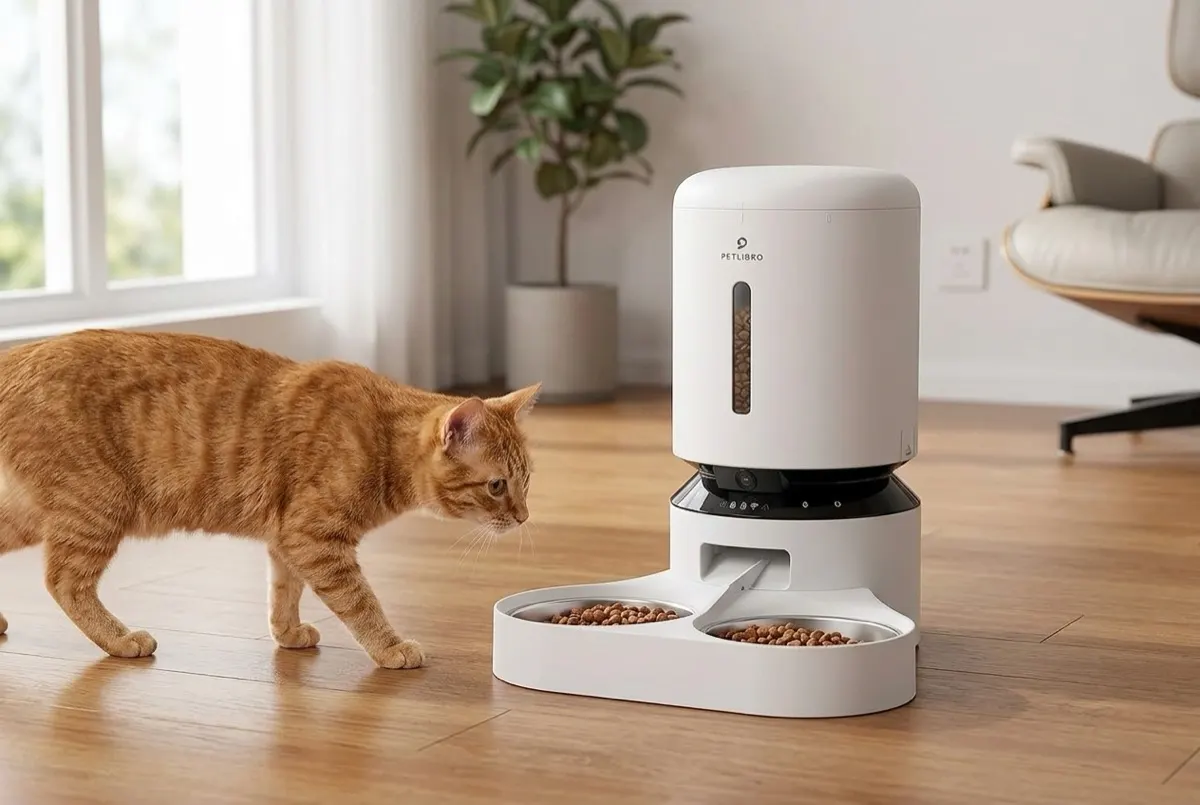
PETLIBRO Camera Feeder Review: Feed and Watch in One Device
1080p HD, night vision
Two-way talk
2.4GHz Wi-Fi
Low food, motion, sound
Methodology & sources
TestedThis review is backed by a validated long-term test record retained by Sofia Marsh.
Verified on August 8, 2026
Pros
- 1080p HD camera with night vision streams to the app
- Two-way audio lets you hear and speak at mealtime
- Motion and sound alerts flag activity around the bowl
- Programmable scheduling with portion control
Cons
- Dry food only, like most hopper feeders
- Camera and alerts depend on a stable 2.4GHz connection
- A single dispensing point cannot separate two cats' portions
Best for
- Owners who want to watch meals, not just schedule them
- One or two-cat homes needing remote check-ins
- People reassured by seeing a pet eat while away
Spec comparison
| Spec comparison | PETLIBRO Automatic Feeder with Camera | PETLIBRO Granary WiFi Automatic Feeder | PetSafe Smart Feed with 2-Pet Meal Splitter |
|---|---|---|---|
| Camera | 1080p HD with night vision | — | — |
| Connectivity | 5G Wi-Fi (2.4GHz) | 5G Wi-Fi (2.4GHz) | 2.4GHz Wi-Fi (802.11b/g/n) |
| Audio | Two-way talk | — | — |
| Scheduling | Programmable daily meals | Up to 10 meals per day | Up to 12 meals per day |
| Alerts | Low-food, motion, and sound | — | — |
| Suited for | Up to two cats | — | — |
| Freshness | Sealed hopper with desiccant compartment | Desiccant bag compartment in lid | — |
| Power | Adapter with battery backup | Adapter with battery backup | AC adapter, 4 D-cell battery backup |
| Capacity | 5L hopper | — | — |
| App required? | Yes for scheduling and camera; saved schedule still runs if Wi-Fi drops | Yes for scheduling; saved schedule still runs if Wi-Fi drops | Yes for scheduling (My PetSafe app); Feed Now button feeds manually |
| Warranty | 24-month warranty | 24-month warranty | 1-year limited warranty (US) |
| Dimensions | 13 x 7.5 x 7.5 in (34 x 19 x 19 cm) | 13.4 x 7.5 x 7.5 in (34 x 19 x 19 cm) | — |
| Hopper capacity | — | 5L | 24 cups (about 6 L) |
| Portion size | — | 1 to 50 portions per meal | 1/8 cup to 4 cups total per meal |
| Sensors | — | Low-food sensor | — |
| Voice | — | 10-second meal-call recorder | — |
| Bowl | — | Detachable, dishwasher-safe | — |
| Bowls | — | — | Two stainless steel, meal split equally |
| Splitter | — | — | Divides each meal evenly, with a privacy panel |
| Food type | — | — | Dry and semi-moist, kibble to half an inch |
| Food sensors | — | — | Low and empty alerts to the app |
| Voice control | — | — | Alexa via Amazon Echo |
An automatic feeder answers the question "did the cat get fed." A camera answers the question "is the cat all right." For a long time those were two separate devices on two separate corners of the room. The PETLIBRO Automatic Feeder with Camera folds them into one, and for a particular kind of owner, the anxious one who works away from home and lies awake wondering whether the cat is eating, that combination is more than the sum of its parts.
The pitch is simple: the feeder still dispenses measured dry meals on a schedule, but a built-in 1080p camera points at the bowl so you can watch it happen. Add two-way audio and motion and sound alerts, and the device stops being a silent appliance and becomes a window into the one moment of the day when you can most reliably observe a cat, when it comes to eat. Whether that is worth choosing over a plain feeder comes down to how much that reassurance means to you.
Feeder first, camera second
It helps to be clear about the hierarchy. This is a feeder that happens to have a camera, not a security camera that happens to dispense food, and judging it on those terms keeps expectations honest. As a feeder it does the core job: a hopper of dry kibble, a programmable schedule, portion control, and the sensors and alerts that make automated feeding trustworthy. The camera is the differentiator layered on top, aimed squarely at the bowl rather than at the whole room.
That framing matters because it sets the right comparison. The question is not whether this camera rivals a dedicated room camera on coverage, since a fixed lens over a food station never will. The question is whether adding eyes and a voice to the feeding station is worth it, and for the owner who mostly wants to confirm the cat is eating and looks well, a camera pointed exactly where the cat reliably appears is often more useful than a wide room view where the cat is off-frame most of the day.
The 1080p camera and night vision
The camera records in 1080p HD, which is more than enough resolution to see a cat clearly at the short distance between lens and bowl. You are not trying to read a licence plate across a car park; you are checking whether the cat came to eat, whether it finished, and whether it looks and moves normally. At that range, 1080p delivers a crisp, reassuring picture that answers those questions at a glance.
Night vision is a genuinely important inclusion rather than a box-tick, because cats are crepuscular and do much of their eating at dawn, at dusk, and through the night. A daytime-only camera would miss a large share of a cat's actual mealtimes. Infrared night vision keeps the bowl visible in the dark, so a scheduled 3am meal is something you can still check on rather than a blind spot. For owners whose cats are most active precisely when the house is dark, that after-hours visibility is a large part of the device's value.
There is a quieter benefit to watching meals that owners discover over time. Mealtime is when subtle changes in a cat often first become visible: a hesitation to eat, a reluctance to chew on one side, eating far less than usual, or simply not showing up when the food arrives. None of these is a diagnosis, but all of them are the kind of early behavioural signal that a cat otherwise hides and an absent owner would never catch. A camera trained on the bowl turns the most reliable daily observation point into something you can review from anywhere, and a persistent change in how a cat approaches food is a sensible prompt to consult a veterinarian.
Two-way audio at mealtime
The two-way audio turns a one-way window into an actual interaction. Through the app you can hear what is happening around the feeder and speak back, and at mealtime that is more meaningful than it sounds. Calling to a cat as the food dispenses reinforces the feeding cue, reassures a nervous animal that the familiar voice is still part of the routine, and lets an owner who is simply missing their pet share a small moment across any distance.
There are limits to keep in mind. Some cats find a disembodied voice from a machine puzzling or even startling at first, and audio quality on any small connected device is functional rather than hi-fi. But used gently, the ability to speak to a cat at the one time it reliably comes to a fixed spot is a warmer feature than a spec sheet conveys, and it is often the detail owners end up using most.
Motion and sound alerts
The camera is not just a live view you have to remember to open; it watches for you. Motion and sound alerts notify the app when there is activity around the bowl, which flips the model from you checking on the cat to the device telling you when the cat is present. Rather than opening a dead feed and seeing an empty bowl, you get a nudge at the moment the cat actually appears, which is when watching is worthwhile.
Combined with the low-food sensor, these alerts form a small web of reassurance. A low-food warning tells you the hopper needs attention, a motion alert tells you the cat came to eat, and a quiet stretch with no motion around expected mealtimes is itself information worth noticing. As with any motion detection, expect the occasional alert from a passing shadow or a second pet, but the net effect is a feeder that keeps you informed instead of requiring you to check.
Sized for two cats
PETLIBRO positions this feeder as suitable for up to two cats, and it is worth understanding exactly what that does and does not mean. The capacity, scheduling, and portioning are sized to feed two cats across a day, so a two-cat household can run the whole feeding routine through one station. What a single-outlet feeder cannot do is enforce which cat eats which portion; both cats eat from the same bowl, and a dominant eater can still take more than its share.
For two cats with similar needs and no serious food competition, one station works well and the camera actually helps by letting you see how the two share the bowl. For cats on different diets, or where one bullies the other away from food, the honest answer is the same as for any shared feeder: separate stations remain the reliable way to control who eats what. The camera makes the dynamic visible, which is useful, but visibility is not the same as control.
Scheduling and portions
Underneath the camera, the feeding fundamentals are the reason to trust the device day to day. Meals are programmable on a schedule with adjustable portions, so a fixed daily ration can be split into the small, frequent servings that suit a cat's digestion and weight management better than one large bowl. Setting the schedule to the cat's natural rhythm, and the portions to a vet-guided daily total, lets the feeder hold a consistency that a human calendar rarely can.
As with every units-based feeder, the sensible first step is to weigh a few dispensed portions and calibrate, since the feeder's serving units will not map exactly to the scoop an owner used by eye. A short calibration turns approximate portions into accurate ones, and from there the schedule simply runs. The camera adds a pleasant layer here too: you can watch whether a cat finishes a given portion and adjust the size based on what you actually see rather than guesswork.
Freshness, reliability, and power
The feeding hardware carries the reliability features owners should expect. A sealed hopper with a desiccant compartment keeps dry food fresh across the days it sits waiting, since damp or stale kibble is food a cat refuses and a silent way for an automatic feeder to fail. The low-food sensor guards against the empty-bowl scenario by warning before the hopper runs out, and battery backup keeps the schedule alive through a power cut so an outage does not become a missed meal.
That last point deserves emphasis for a device you rely on while away. The whole value of a feeder collapses if it stops the instant the power flickers, so keeping fresh backup batteries installed as always-on insurance is the right habit. A camera feeder that quietly loses its schedule during a storm, and greets the returning owner with a hungry cat and a dark feed, has failed at the job that matters most.
The app and Wi-Fi
Everything distinctive here, the live view, night vision, two-way audio, motion and sound alerts, plus the schedule and low-food warnings, runs through the PETLIBRO app over a 2.4GHz Wi-Fi connection. That makes signal strength at the feeding spot a real consideration, because a camera stream is far more bandwidth-hungry than a simple schedule sync. A connection that is fine for a basic feeder can stutter when asked to carry HD video, so the feeder wants a solid position within reliable coverage.
The good news is that the pre-programmed schedule lives on the device, so meals still dispense even if the network drops; it is the camera and remote features that suffer on weak Wi-Fi. Setting the feeder up where the signal is strong, and confirming the video actually streams smoothly and the alerts reach the phone, is the setup step most worth getting right, because a camera you cannot connect to is just an ordinary feeder with a lens.
Privacy and the connected camera
Any camera streaming from inside a home over the internet deserves a moment of thought, and it would be dishonest to skip it. A connected feeder camera lives in a kitchen or living area and points into the home, so the same basic hygiene that applies to any smart camera applies here: use a strong, unique account password, enable any available extra account protection, and keep the device firmware current through the app. These are not reasons to avoid the product, but they are responsibilities that come with putting a networked camera in a living space.
It is also worth siting the feeder thoughtfully so the lens covers the feeding station rather than sweeping across the whole room, both for the cat's sake and for the household's. A camera aimed at a bowl is doing its job; one angled to watch the entire living room is collecting more than the task requires. A little care in placement keeps the feature focused on what it is for.
Cleaning
A feeder is a food-contact appliance, and the camera does not change that. The bowl and food path need regular cleaning to prevent the film and odours that build up in any feeding station, and a detachable bowl makes that routine quick rather than a chore. The hopper and chute should be emptied and wiped on a schedule to clear dust and stop kibble oils turning rancid, and the desiccant kept clean and current.
The one addition the camera brings to the cleaning list is the lens. A smeared or dusty lens quietly degrades the very feature that sets this feeder apart, turning a crisp 1080p view into a foggy one, so a gentle wipe of the lens belongs alongside the bowl on the maintenance routine. It takes seconds and preserves the clarity you paid for.
A combined device, or two separate ones
The real decision many buyers face is whether to buy this combined unit or a plain feeder plus a separate room camera. Each approach has a logic. Separate devices let you place a wide-angle camera wherever it best covers the room and choose a feeder purely on feeding merits, and if one device fails the other keeps working. The combined feeder trades that flexibility for simplicity: one device, one app, one power lead, and a camera guaranteed to be pointed at the exact spot the cat reliably visits.
For an owner whose main worry is specifically whether the cat is eating and looks well, the combined device is often the better answer, because it fuses the two functions at the one moment they overlap. For an owner who wants broad room surveillance and independent redundancy, separate devices make more sense. Neither is wrong; the combined feeder simply optimises for the mealtime check-in above general coverage.
Who should consider it
This feeder suits owners who want reassurance, not just automation. If you work away from home and find yourself wondering whether the cat is eating, whether it looks well, or simply missing the animal during the day, a feeder that lets you watch and speak at mealtime addresses exactly that worry. It is a natural fit for one or two-cat homes that can run feeding through a single station, and for anyone who values seeing a pet eat over merely trusting that it did.
The night vision widens its appeal to owners whose cats eat in the dark, and the motion and sound alerts make it genuinely low-effort, since the device tells you when the cat appears rather than asking you to keep checking.
Who should skip it
Wet, fresh, or raw-food households should skip it, as it is a dry-food feeder like most in its class. Owners who actively do not want a camera in a living space, whether for privacy or simplicity, will be happier with a plain feeder and should not pay for a lens they will disable. And homes with weak Wi-Fi at the feeding spot will struggle to stream the video that justifies the model, so a poor connection is a real reason to either fix the network first or choose a simpler feeder.
Verdict
The PETLIBRO Automatic Feeder with Camera succeeds by knowing what it is: a dependable dry-food feeder with a purpose-built camera aimed where it matters. On its published specifications the feeding side carries the reliability owners need, scheduled portions, a low-food sensor, freshness protection, and battery backup, while the 1080p night-vision camera, two-way audio, and motion and sound alerts add a layer of reassurance that a plain feeder cannot. For the anxious owner who wants to confirm the cat is eating and looks well, that fusion of feeding and watching at the one predictable moment of the day is genuinely valuable.
The caveats are the familiar ones for its category, sharpened by the camera. It feeds dry food only, a single station cannot referee two competing cats, and the streaming features lean harder on a stable connection than a basic feeder does, with the usual privacy care any home camera warrants. Accept those boundaries and site it on strong Wi-Fi, and it delivers a rare thing: the ability not just to feed a cat from anywhere, but to see, for yourself, that the cat is all right.
Editorial summary
Editorial overview of the PETLIBRO Automatic Feeder with Camera based on published manufacturer specifications, the app feature list, and support guidance.
Where to buy
Check the merchant for the current price and availability. We may earn a commission.