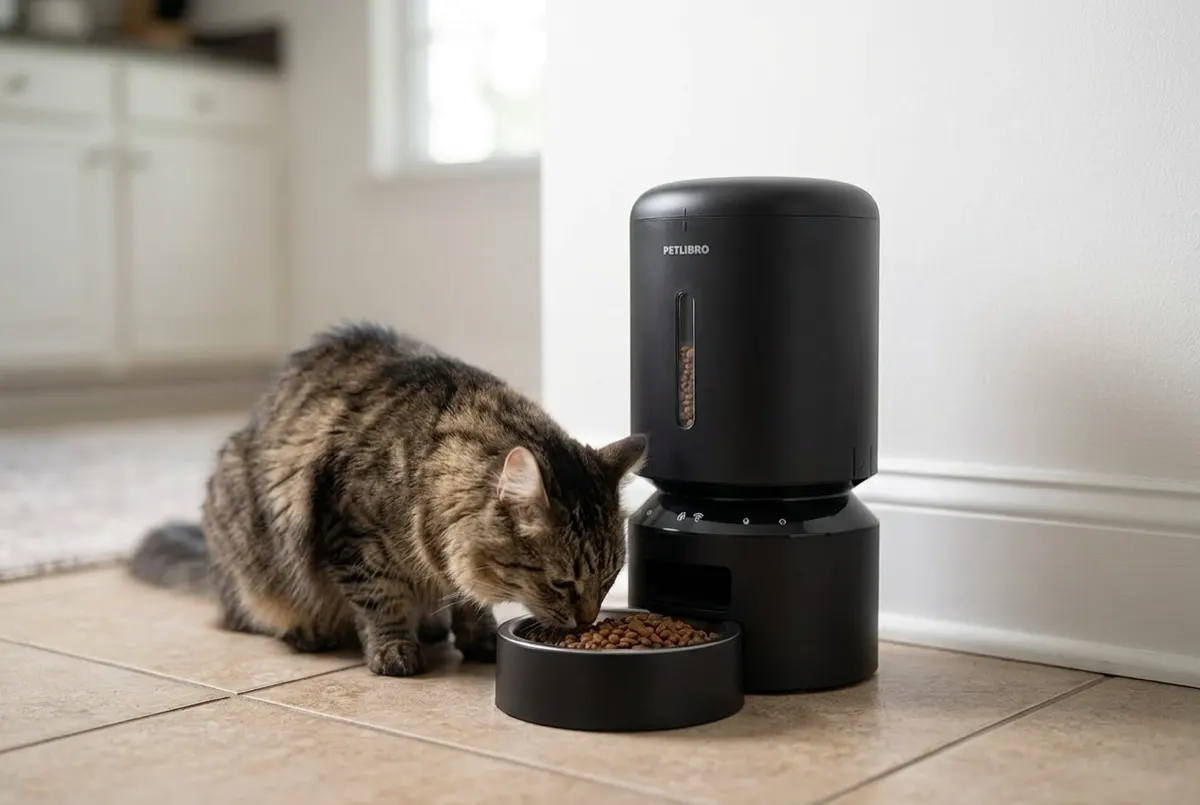
PETLIBRO Granary WiFi Feeder Review (2026): Scheduled Meals Without the Guilt
5L
2.4GHz Wi-Fi
Up to 10 per day
1 to 50 per meal
Quick answer
The PETLIBRO Granary WiFi Automatic Feeder dispenses dry food from a 5L hopper on schedules of up to ten meals per day, with each meal adjustable from 1 to 50 portions. It connects over 2.4GHz Wi-Fi for app scheduling and low-food alerts, and a battery backup keeps meals on time during power cuts. It handles dry kibble only, with no wet-food option and no built-in camera.
Methodology & sources
TestedThis review is backed by a validated long-term test record retained by Sofia Marsh.
Verified on August 8, 2026
Pros
- 5L hopper covers multi-day scheduling for cats and small dogs
- Fine portion control across up to 10 meals a day
- Freshness lid holds a desiccant bag to keep kibble dry
- Low-food sensor warns before the hopper empties
Cons
- Dry food only, with no wet or fresh option
- Very large or oddly shaped kibble can bridge the chute
- App features depend on a stable 2.4GHz connection
Best for
- Owners who work long or irregular hours
- Cats and small dogs on portion-controlled diets
- Grazers who do better with several small scheduled meals
Spec comparison
| Spec comparison | PETLIBRO Granary WiFi Automatic Feeder | PETLIBRO Automatic Feeder with Camera | PetSafe Smart Feed with 2-Pet Meal Splitter |
|---|---|---|---|
| Hopper capacity | 5L | — | 24 cups (about 6 L) |
| Connectivity | 5G Wi-Fi (2.4GHz) | 5G Wi-Fi (2.4GHz) | 2.4GHz Wi-Fi (802.11b/g/n) |
| Scheduling | Up to 10 meals per day | Programmable daily meals | Up to 12 meals per day |
| Portion size | 1 to 50 portions per meal | — | 1/8 cup to 4 cups total per meal |
| Freshness | Desiccant bag compartment in lid | Sealed hopper with desiccant compartment | — |
| Sensors | Low-food sensor | — | — |
| Power | Adapter with battery backup | Adapter with battery backup | AC adapter, 4 D-cell battery backup |
| Voice | 10-second meal-call recorder | — | — |
| Bowl | Detachable, dishwasher-safe | — | — |
| App required? | Yes for scheduling; saved schedule still runs if Wi-Fi drops | Yes for scheduling and camera; saved schedule still runs if Wi-Fi drops | Yes for scheduling (My PetSafe app); Feed Now button feeds manually |
| Warranty | 24-month warranty | 24-month warranty | 1-year limited warranty (US) |
| Dimensions | 13.4 x 7.5 x 7.5 in (34 x 19 x 19 cm) | 13 x 7.5 x 7.5 in (34 x 19 x 19 cm) | — |
| Camera | — | 1080p HD with night vision | — |
| Audio | — | Two-way talk | — |
| Alerts | — | Low-food, motion, and sound | — |
| Suited for | — | Up to two cats | — |
| Capacity | — | 5L hopper | — |
| Bowls | — | — | Two stainless steel, meal split equally |
| Splitter | — | — | Divides each meal evenly, with a privacy panel |
| Food type | — | — | Dry and semi-moist, kibble to half an inch |
| Food sensors | — | — | Low and empty alerts to the app |
| Voice control | — | — | Alexa via Amazon Echo |
The case for an automatic feeder is rarely about laziness and almost always about consistency. A cat's digestion, weight, and behaviour all respond to being fed the same amount at the same times every day, and that is precisely the thing a human schedule keeps getting in the way of. Late shifts, early starts, weekends away, and the simple reality of a pet that wakes at five demanding breakfast all pull against the routine an animal thrives on. The PETLIBRO Granary is designed to hold that routine steady regardless of what the human day looks like.
Within PETLIBRO's broad feeder line-up, the Granary is the WiFi-connected dry-food workhorse: a 5L hopper, app scheduling, and the sensors and backups that separate a feeder you can trust from one you have to babysit. It is not the flashiest model in the range, and it deliberately leaves the camera to other products, but it concentrates on doing the core job, getting the right amount of food into the bowl at the right time, reliably enough that you can stop thinking about it.
What the Granary is built to do
At its heart the Granary is a programmable dry-food dispenser with a generous reservoir and a connected brain. You load the hopper with kibble, set a schedule in the app, and the feeder releases measured portions at the times you choose. The 5G WiFi label refers to PETLIBRO's fast pairing rather than a cellular connection; the device runs on standard 2.4GHz home WiFi, which is the band that reaches furthest through walls and is the right choice for a feeder that often lives in a kitchen or utility corner.
Everything else on the device exists to make that core function dependable. The freshness lid protects the food, the low-food sensor warns you before the hopper runs dry, the battery backup covers power cuts, and the voice recorder softens the transition from human feeding to machine feeding. None of these is glamorous, but collectively they are what let an owner leave the house without wondering whether the cat will actually be fed.
Portion control and scheduling
The scheduling is where the Granary proves its worth. It supports up to ten meals a day, with each meal adjustable from one to fifty portions, and that granularity is more useful than it first sounds. A cat managing its weight benefits from several small meals rather than one large bowl, both because it curbs the gorge-and-beg cycle and because it more closely mimics how a cat would naturally eat across a day. Ten programmable meals gives you room to spread a fixed daily ration into small, frequent servings.
Fine portion steps also matter for accuracy. Weight management in cats is largely a numbers game, and a feeder that can only dispense in coarse increments makes it hard to hit a vet-recommended daily amount. Being able to tune each meal in small units lets you dial the total to the target and then leave it, which is exactly the kind of quiet consistency that keeps a cat at a healthy weight without daily human arithmetic. As always, the portion figure is a count of the feeder's units rather than an exact grammage, so a short calibration against a kitchen scale early on pays off.
The 5L hopper and freshness
A 5L hopper is large for a cat feeder, and its size is a deliberate reliability feature rather than mere capacity for its own sake. A bigger reservoir means longer between refills, which matters most when an owner is away for a weekend and needs the feeder to run unattended for several days. Fewer refills also means fewer chances to forget one, and a hopper that holds days of food is a hopper that forgives a busy week.
Capacity is only useful if the food stays good, which is where the freshness design comes in. The lid includes a compartment for a desiccant bag that absorbs moisture, keeping kibble dry and palatable across the days it sits in the reservoir. Dry food that goes stale or damp is food a cat will refuse, quietly defeating the entire point of an automatic feeder, so the sealed lid and desiccant are doing real work. Keeping the seal clean and swapping the desiccant on schedule is a small maintenance habit that protects the whole system.
Reliability: sensors, jams, and kibble size
The failure mode every feeder owner fears is the empty bowl discovered too late, and the Granary addresses it from two directions. A low-food sensor watches the hopper level and sends an alert before it runs out, giving you warning to refill rather than a nasty surprise. That single feature converts the feeder from something you must monitor into something that tells you when it needs attention.
The other classic failure is a jam, and here the honest advice is about kibble. Any auger-and-chute feeder can be bridged by kibble that is too large, too oddly shaped, or too irregular, and the Granary is no exception. It handles typical dry cat food and small-dog kibble well, but very large, round, or awkwardly shaped pieces are the enemy of smooth dispensing. The practical takeaway matches every reliable feeder: match the kibble to the machine, favouring small, uniform, dry pieces, and the mechanism stays consistent. Force unusual food through it and jams become a question of when, not if.
Power and battery backup
A feeder is only as reliable as its power, and a device that stops working the moment the mains flickers is a liability for the exact scenario, an owner away from home, where it matters most. The Granary runs on a mains adapter for everyday use but includes battery backup that keeps the schedule alive through a power cut. That backup is not a minor bullet point; it is the difference between a feeder you can genuinely trust over a weekend away and one that quietly fails during a storm.
The sensible practice is to keep fresh backup batteries installed even while running on mains, so the fallback is always ready. A feeder that loses its schedule during an outage and greets the returning cat with an empty bowl has failed at its one job, and the battery backup exists precisely to prevent that. Treating it as always-on insurance rather than an afterthought is the right mindset.
The voice recorder
Cats learn the sound of feeding fast, and the Granary uses that to its advantage with a ten-second voice recorder that plays before each meal. Recording a familiar call, the same words used at feeding time, gives the cat a consistent cue that food is arriving and helps bridge the psychological gap between being fed by a person and being fed by a machine. For a nervous or newly transitioned cat, that continuity can make the difference between accepting the feeder and treating it with suspicion.
It is a small feature but a genuinely thoughtful one. The mechanical whir of dispensing already acts as a cue over time, but a warm, familiar voice attached to it speeds the association and takes some of the coldness out of automated feeding. It will not win anyone over on its own, yet it is exactly the kind of detail that makes the daily experience feel less like outsourcing a pet to an appliance.
The app and WiFi
The Granary's schedule, portion settings, low-food alerts, and history all live in the PETLIBRO app over a 2.4GHz WiFi connection. That connection is a dependency worth planning for: the feeder needs reliable signal wherever it sits, and kitchens and utility rooms are often at the edge of home coverage. Weak WiFi does not stop the pre-programmed schedule from running, since that is stored on the device, but it does cut off the remote adjustments, alerts, and history that make the connected version worth choosing.
The app also enables the reassurance of checking in and adjusting a meal remotely, which is genuinely useful when plans change and a return home is delayed. Setting the feeder up on a solid connection, and confirming the alerts actually reach the phone, is the setup step most worth getting right, because a low-food warning that never arrives is no warning at all.
Cleaning and the stainless bowl
Hygiene is where feeders quietly diverge, and the Granary's detachable stainless steel bowl is the right answer. Stainless resists the bacterial film and odours that plastic bowls accumulate, it is gentler on the chins of cats prone to feline acne, and it is straightforward to clean. A removable, dishwasher-friendly bowl turns the least pleasant part of feeder ownership into a quick routine rather than a chore.
The rest of the unit needs periodic attention too. The hopper and chute should be emptied and wiped down on a schedule to clear dust and stop old kibble oils from turning rancid, and the desiccant compartment should be kept clean and current. None of this is demanding, but a feeder is a food-contact appliance used every day, and treating it like one keeps the food it dispenses appealing.
Wet food, and what it can't do
The Granary's clearest limitation is inherent to its design: it dispenses dry food only. There is no wet, fresh, or raw option, and no cooling, so a household committed to a wet-food diet is looking at the wrong tool entirely and should consider a chilled wet-food feeder instead. This is not a shortcoming so much as a category boundary, but it is the first thing a wet-food owner needs to know before buying.
It is also worth stating plainly that a feeder manages the mechanics of feeding, not the judgement behind it. The right daily amount, the right food, and any dietary restriction are decisions for the owner and the veterinarian; the Granary simply executes the plan with consistency. It removes the human variability from feeding, which is its great strength, but it does not remove the responsibility for what the plan should be.
Transitioning a cat to the feeder
Switching a cat from hand-fed meals to an appliance is the step most owners underestimate, and getting it right in the first week determines whether the feeder becomes a trusted fixture or an object of suspicion. Cats are creatures of ritual, and the sudden appearance of a whirring machine where a person used to stand can unsettle a sensitive animal. The smoother path is gradual: place the feeder near the existing bowl for a few days so it becomes part of the furniture before it ever dispenses, then begin with meals at the cat's established times rather than imposing a new schedule at the same moment as new hardware.
The voice recorder earns its keep during this transition more than at any other time. Pairing a familiar call with the first automated meals gives the cat a bridge between the old routine and the new one, and most cats connect the sound to food within days. It also helps to keep one or two hand-fed meals in the early days so the change feels like an addition rather than a replacement, tapering them off only once the cat approaches the feeder confidently on its own.
Expect a little trial and error with portions and timing as well. The feeder's units rarely map exactly to the scoop an owner used by eye, so the first week is the time to weigh a few dispensed meals and adjust until the daily total matches the intended ration. Cats also vote with their behaviour: a cat still begging loudly after meals may need the same ration split into more frequent servings, which the ten-meal schedule makes easy to arrange. A week of small adjustments turns the feeder from a rough approximation into a precise, trusted part of the day.
Multi-pet and multi-feeder homes
In a single-cat home the Granary is straightforward. In a multi-cat home it takes a little thought, because a shared feeder cannot tell one cat from another and a dominant eater may take more than its share. The usual solutions apply: a feeder per cat in separate locations, or careful scheduling, since the device controls when and how much is dispensed but not who reaches the bowl first. For households already running a schedule across several feeders, the app-based control makes coordinating them less of a juggling act.
For small dogs the Granary works well within the same limits, provided the kibble suits the mechanism and the portions are set to a dog's very different daily needs. As with cats, it shines for a pet on a controlled diet whose owner wants the day's ration delivered in measured, predictable instalments rather than one bowl to graze at will.
Who should consider it
The Granary is a strong fit for owners whose schedules fight against their pet's routine. If you work long or irregular hours, travel for the occasional weekend, or simply have a cat that demands breakfast before dawn, a large-hopper connected feeder restores the consistency the animal needs. It is especially valuable for cats and small dogs on portion-controlled diets, where the fine meal-by-meal adjustment and reliable scheduling do real work toward a healthy weight.
It also suits grazers who do better on several small meals than one large bowl, and any owner who wants the reassurance of low-food alerts, remote adjustment, and a battery backup that keeps working when the power does not.
Who should skip it
Households that feed wet, fresh, or raw food should skip it, because the Granary is a dry-food device and nothing will change that. Owners who specifically want a built-in camera to watch mealtimes will prefer a camera-equipped feeder instead. And anyone whose feeding spot has no reliable 2.4GHz WiFi loses the connected features that justify choosing this model over a simpler timer-based feeder, so weak coverage is a genuine reason to look elsewhere or to fix the network first.
Verdict
The PETLIBRO Granary WiFi Automatic Feeder is an unglamorous device that does the important thing well. On its published specifications it concentrates on reliability, a large 5L hopper, fine portion control across up to ten daily meals, a low-food sensor, a freshness-preserving lid, and a battery backup that survives power cuts, and reliability is exactly what an automatic feeder must have. The stainless bowl and the familiar-voice recorder round it out with hygiene and a human touch that make the daily experience better than the spec sheet suggests.
Its limits are honest and easy to plan around. It feeds dry food only, it rewards matching the kibble to the mechanism, and its connected features lean on a stable home network. For an owner whose life keeps colliding with a pet's need for routine, the Granary quietly removes that conflict, delivering the right amount at the right time whether or not the human day cooperates. For anyone feeding wet food or hoping for a camera, though, the right PETLIBRO is a different one.
Editorial summary
The PETLIBRO Granary WiFi feeder holds 5L of dry food and schedules up to ten meals a day in 1-50 portion steps, with a low-food sensor and battery backup.
Where to buy
Check the merchant for the current price and availability. We may earn a commission.