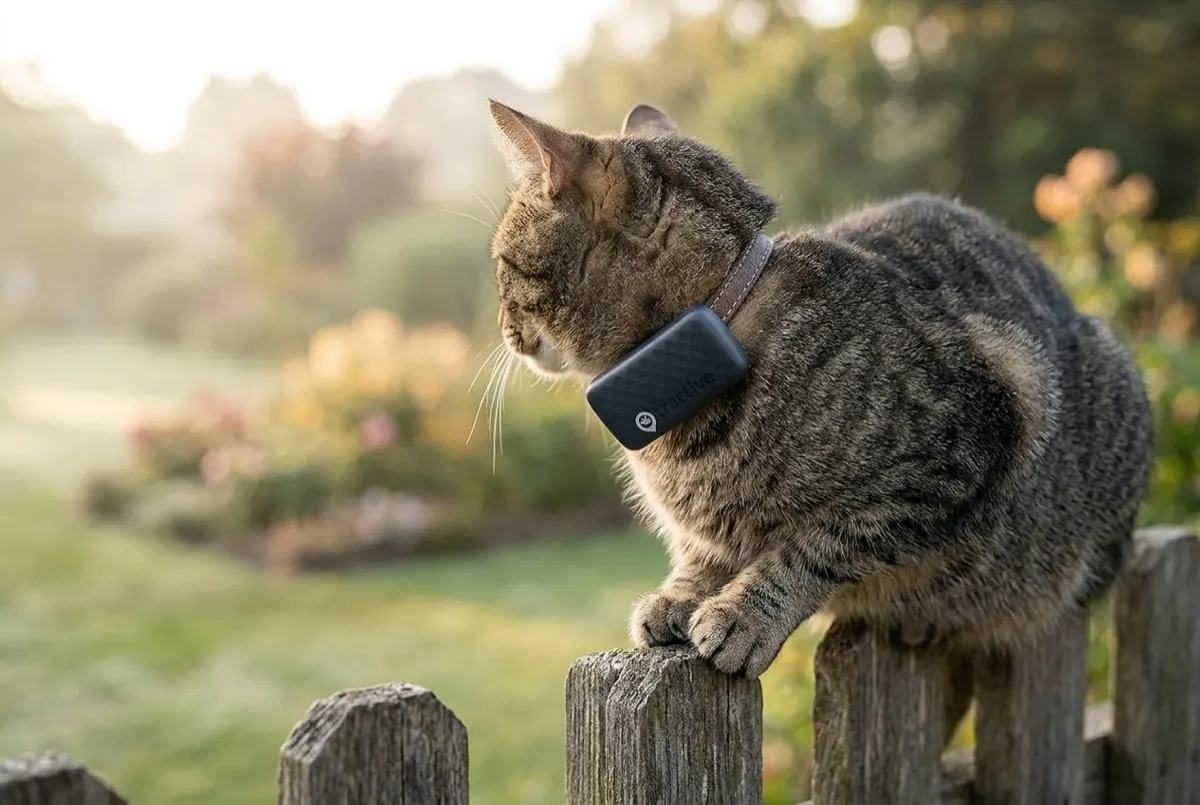
Tractive Smart Cat GPS Tracker Review: Mapping the Secret Life of Cats
GPS with LTE
Unlimited (cellular)
Up to 5 days
Breakaway included
Methodology & sources
TestedThis review is backed by a validated long-term test record retained by Sofia Marsh.
Verified on August 8, 2026
Pros
- Real-time location tracking sized for cats 6.5 lb and up
- Included breakaway collar releases under strain for safety
- Territory map and location history reveal roaming patterns
- Activity and sleep monitoring build a wellness baseline
Cons
- Requires an ongoing cellular subscription to function
- Up-to-five-day battery means frequent charging
- Too large for very small or kitten-sized cats
Best for
- Owners of outdoor or indoor-outdoor cats
- People who want to map where a cat actually roams
- Households near roads, woods, or other cats' territory
Spec comparison
| Spec comparison | Tractive Smart Cat GPS Tracker | Fi Series 3+ Smart Dog Tracker Collar | Tractive Smart Dog GPS Tracker |
|---|---|---|---|
| Positioning | GPS with LTE cellular | — | GPS with LTE cellular |
| Location updates | Real-time (Live mode) | — | Real-time (Live mode) |
| Territory view | Location history and heatmap | — | — |
| Wellness monitoring | Activity and sleep tracking | — | — |
| Battery life | Up to 5 days | Up to 3 months (low activity) | Up to 2 weeks |
| Minimum cat size | 6.5 lb and above | — | — |
| Collar | Breakaway safety collar included | — | — |
| Water resistance | Waterproof casing | — | Waterproof casing |
| Subscription | Cellular service plan required | Membership required (12 months included) | Cellular service plan required |
| Weight | 25 g | — | 39 g (1.4 oz) |
| Connectivity | — | LTE-M cellular + multi-constellation GPS | — |
| Location accuracy | — | About 7 ft under clear skies | — |
| Waterproof | — | IP68 | — |
| Module weight | — | 28 g | — |
| Collar sizes | — | S to XL (11.5 in to 34.5 in neck) | — |
| Warranty | — | 1-year product warranty | — |
| Virtual fence | — | — | Shock-free boundary and escape alerts |
| Health monitoring | — | — | Heart rate, respiratory rate (Premium) |
| Behaviour | — | — | Bark and activity monitoring |
| Minimum dog size | — | — | 8.8 lb and above |
A dog that goes missing usually goes missing loudly and in one direction. A cat that goes missing does something stranger and more worrying: it simply dissolves into the neighbourhood. Cats are secretive, territorial, and extraordinary at hiding, which is exactly why an outdoor cat can vanish for a day or a week with no trail to follow. The Tractive Smart Cat GPS Tracker exists to solve that specific problem, turning a cat's opaque wanderings into a map you can actually read.
Tracking a cat is a harder engineering challenge than tracking a dog, and understanding why explains most of this device's design choices. A cat carries far less weight than a dog, so the tracker has to be small and light. A cat squeezes through gaps and climbs, so the collar has to be safe if it snags. And a cat's outdoor life is a mystery its owner rarely sees, so the real value is not just emergency recovery but the ongoing picture of where the animal goes. This model is built around those cat-specific realities rather than being a dog tracker shrunk down.
Built for a cat's size and habits
The first thing that separates a cat tracker from a dog one is weight. A device that a Labrador never notices can be a genuine burden on a cat, affecting comfort and willingness to wear it at all. Tractive sizes this model for cats of about 6.5 lb and above, and that lower limit matters: below it, the tracker is simply too much hardware for the animal to carry comfortably. Owners of very small or young cats should check the weight guidance honestly rather than hoping a slim cat will tolerate it.
For a cat that clears that threshold, the tracker rides on the collar without dominating it, and cats generally habituate to the added weight within a few days provided the collar itself fits correctly. A tracker that irritates a cat will be groomed at, scratched off, or lost, so comfort is not a nicety here; it is the difference between a device that stays on and one that ends up under the sofa.
The breakaway collar question
Cats and collars have an uneasy relationship for one serious reason: a cat that climbs and squeezes through tight spaces can catch a fixed collar on a branch or a fence and choke. The safety answer is a breakaway collar that releases under strain, and Tractive includes one in the box for exactly this purpose. If the collar snags, it pops open and frees the cat, which is unquestionably the right priority.
That safety mechanism carries an inherent trade-off worth naming, because it is the same trade every responsible cat collar makes. A collar designed to release under strain can also release when you would rather it did not, which means a snagged collar can leave the tracker behind while the cat walks on. It is the correct compromise, safety over retention, but owners should know that a breakaway collar occasionally means finding the tracker in a hedge rather than on the cat. Checking the collar regularly and keeping the location history in mind helps recover a shed tracker quickly.
Live tracking and territory mapping
Like its canine sibling, the cat tracker uses GPS for position and an LTE cellular connection to relay it, giving unlimited range wherever there is coverage. Live tracking switches the device into continuous updates so you can watch the cat move in near real time, which is the mode that matters when a cat has not come home and you need to go and look. Rather than a stale point, you get a moving target you can walk toward.
Beyond the live view, the tracker builds a territory map: a picture of the area a cat actually claims and patrols. Cats are intensely territorial, and their range is often far larger and stranger than owners assume. Seeing that territory drawn out, the gardens visited, the routes taken, the boundaries respected or crossed, is frequently the most surprising and useful thing the device offers, turning an invisible routine into something you can finally see.
Location history and the secret life of cats
The location history is where a cat tracker earns its keep between emergencies. Over days and weeks it accumulates a record of where the cat goes, when, and how far, and that record answers questions owners have wondered about for as long as cats have gone outside. Which neighbour is feeding it? Is it crossing the busy road you worried about? Does it disappear to the same spot every afternoon? The history turns speculation into evidence.
That evidence has practical value beyond curiosity. If a cat is crossing a dangerous road, the history reveals the pattern early enough to change routines or restrict access. If a cat has stopped roaming as far as it used to, that change can be an early hint of illness or injury worth a closer look. A map of normal behaviour makes any departure from normal visible, which is the quiet foundation of catching problems sooner.
Wellness: activity and sleep
Alongside location, this model tracks activity and sleep, building a wellness baseline for the cat much as a fitness band does for a person. It logs how active the cat is across the day and how much it rests, and over time those figures establish what is normal for that individual animal. The point is not the raw numbers but the trend: a cat that suddenly sleeps far more, or moves far less, is telling you something even when it shows no other outward sign.
It is worth being clear that this is wellness monitoring, not veterinary measurement. Activity and sleep trends are prompts to pay attention, and a sustained change is a good reason to consult a veterinarian, not a diagnosis on their own. Read that way, the wellness data adds a gentle early-warning layer to a device most people buy for location, and for an animal as stoic about illness as a cat, any early signal is valuable.
The sleep figures deserve a particular mention, because sleep is one of the few behaviours an owner genuinely cannot observe in an outdoor cat that spends its days elsewhere. A cat that begins resting far more than its own established norm may be conserving energy against pain, infection, or the early stages of a chronic condition, and the tracker surfaces that shift long before it would show up as visible lethargy at home. Paired with the location history, a drop in roaming alongside a rise in sleep is a combination worth taking to a veterinarian.
Battery life and the charging rhythm
Battery life is the honest cost of shrinking a cellular tracker to cat size. Tractive rates this model at up to five days between charges, considerably less than the dog tracker's fortnight, simply because a smaller device holds a smaller battery. In practice that means a genuine charging routine: this is not a device you fit and forget for weeks, but one that comes off every few days for a top-up.
The figure also flexes with use and coverage. Heavy Live tracking during a search drains it faster, and weak cellular signal makes the radio work harder, shortening the interval further. The practical discipline is to build charging into a rhythm the household actually keeps, because a tracker that dies mid-week creates exactly the false confidence that leaves a cat untracked on the day it wanders off.
Coverage and subscription
As with every true GPS tracker, the hardware is only half the product. This model needs a Tractive subscription to carry its position data over the cellular network, and without that plan it does nothing. Anyone weighing it against a cheap Bluetooth tag must count the recurring service as part of the real cost from the outset, and confirm that coverage extends across the area the cat actually roams.
That subscription model is intrinsic to cellular tracking rather than a quirk of this product; the mobile network has to be paid for every day the device reports. Check which features the chosen plan tier includes before assuming a capability is available, and treat coverage as a hard requirement, since a tracker in a cellular dead zone cannot report a position no matter how good its hardware.
Durability and weatherproofing
An outdoor cat lives outdoors in all weather, so the tracker is built to match. Its housing is waterproof, shrugging off rain, wet grass, and the damp hedges and undergrowth a cat pushes through daily. That ruggedness is essential rather than optional for a device that will spend its life exposed to the elements on an animal that actively seeks out tight, dirty, and wet places.
Durability also matters because cats are hard on their gear in ways dogs are not. Squeezing under fences, climbing, and grooming all put the tracker through repeated stress, and a housing that cracks or leaks would fail quickly. The sealed, weatherproof build is designed for precisely that punishment, which is what allows the device to keep reporting from the places a cat is most likely to get into trouble.
The app
Everything the tracker does reaches you through the Tractive app: the live map, the territory view, the location history, and the activity and sleep trends. The app supports several people following the same cat, which helps in a household where more than one person might need to go looking. Configuring that sharing in advance means whoever is nearest can respond rather than the alert reaching a single phone that happens to be across town.
The dependence on the app is the same as for any connected device. A signed-out app, a dead phone, or disabled notifications all blunt the tracker's usefulness at the moment it matters most, so keeping the app set up and alerts switched on is part of using the device properly rather than an afterthought.
Indoor cats: do you need this?
For a strictly indoor cat that never has the chance to escape, this tracker is hard to justify. The whole value proposition rests on a cat that goes outside, whether by design or by the occasional dash through an open door. If a cat's only escape risk is that rare bolt, the calculation is personal: some owners want the safety net for that one-in-a-hundred day, others reasonably decide the ongoing subscription is not worth it for a cat that lives inside.
The clearest case for buying is the indoor-outdoor cat, the animal that comes and goes freely and disappears into a neighbourhood no owner can see. That is the cat this device was designed for, and the one whose safety it most improves.
A microchip is not a tracker
A common and dangerous assumption is that a microchipped cat is already covered. A microchip and a GPS tracker do completely different jobs, and confusing them leaves a cat far less protected than an owner believes. A microchip is a permanent identifier with no power and no location function whatsoever. It only helps after a lost cat has already been found and physically carried to a vet or shelter with a scanner, at which point the chip links the animal back to its owner. It is essential, but it is passive and reactive.
A GPS tracker is the active half of the equation. It tells you where the cat is right now so you can go and get it, before it is injured, before someone else adopts it, and without relying on a stranger happening to catch it and scan it. The two are complements, not alternatives: the chip proves the cat is yours once recovered, and the tracker is what lets you do the recovering. A responsible outdoor-cat setup ideally has both, and treating the tracker as a live rescue tool while the chip stays the permanent backstop is the way to think about it.
The first week
The opening days set up everything the tracker will later do well. Fit the collar so it is snug but safe, give the cat a few days to accept the added weight, and resist the urge to keep grabbing the animal to check the device, since a stressed cat associates the collar with being handled and will work harder to lose it. Cats that adjust to a well-fitted collar in the first week tend to wear it indefinitely without complaint.
The location history and wellness baseline also begin forming in that first week, and both are more useful once they have some data behind them. Let the territory map fill in over several days before drawing conclusions about where the cat goes, and let the activity and sleep figures gather a quiet baseline before reading anything into a single day. A little patience early turns the tracker from a novelty into a genuine record of the cat's normal life, which is exactly what makes any later change stand out.
Who should consider it
This tracker is for owners of cats that go outside and whose territory is a mystery. If a cat roams freely, crosses roads, disappears for hours, or lives in an area with traffic, woods, or rival cats, the combination of live tracking, territory mapping, and location history offers both faster recovery and a genuine window into the animal's hidden routine. The included breakaway collar shows the design takes cat safety seriously, and the activity and sleep trends add a quiet health dimension on top.
It also suits multi-person households that can share the search, and owners who simply want, after years of wondering, to finally see where their cat actually goes.
Who should skip it
Owners of strictly indoor cats with no realistic escape risk will get little from it and should weigh the recurring cost carefully. Kittens and cats below the recommended weight should not wear it, since it is too much hardware for a small animal to carry comfortably. And anyone unwilling to keep up a charging routine every few days, or to pay an ongoing subscription, will find the device frustrating rather than reassuring; a tracker used half-heartedly is worse than none at all.
Verdict
The Tractive Smart Cat GPS Tracker takes the hard problem of tracking a secretive, lightweight, escape-prone animal and, on the strength of its published specifications, solves it thoughtfully. Real-time live tracking, an unlimited cellular range, a revealing territory map, and a safety-first breakaway collar make it a serious tool for the indoor-outdoor cat, and the activity and sleep monitoring quietly extend it into everyday wellness. For the owner who has spent years wondering where the cat vanishes to, it finally draws the map.
The compromises are the price of cat-sized cellular tracking. The battery lasts days rather than weeks and demands a charging habit, the device depends entirely on a paid subscription and adequate coverage, and it is too large for the smallest cats. Accept the charging rhythm, confirm coverage where the cat roams, and read the wellness data as a prompt rather than a diagnosis, and the tracker delivers something genuinely rare: visibility into an animal built to keep its movements hidden.
Editorial summary
Editorial overview of the Tractive Smart Cat GPS Tracker based on published manufacturer specifications, plan terms, and support guidance.
Subscription math
Tractive Smart Cat GPS Tracker · $9.00 per month
| Period | Device only | Device + subscription |
|---|---|---|
| 1 year | $49.99 | $157.99 |
| 3 years | $49.99 | $373.99 |
| 5 years | $49.99 | $589.99 |
Tractive Basic (1-Year Plan) pricing, checked August 7, 2026.
Where to buy
Check the merchant for the current price and availability. We may earn a commission.