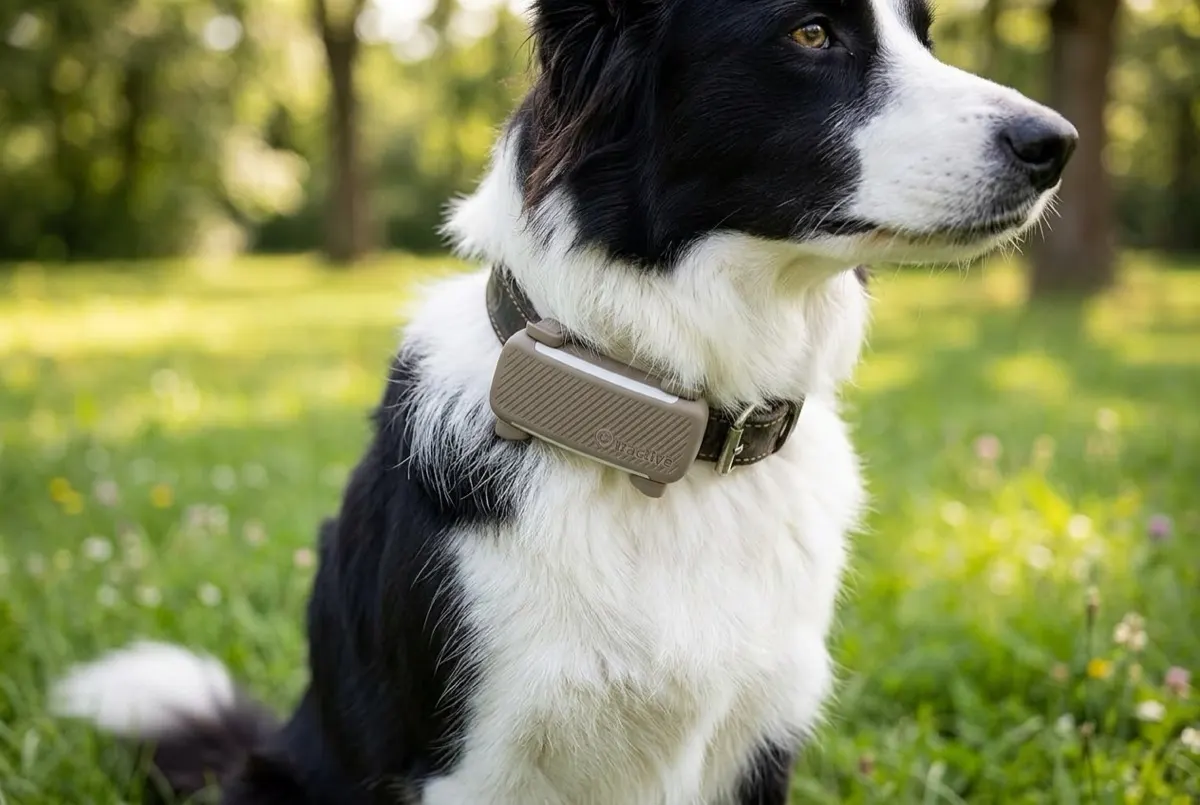
Tractive Smart Dog GPS Tracker Review (2026): Location, Then Health
GPS with LTE
Unlimited (cellular)
Up to 2 weeks
Heart and respiratory rate
Quick answer
The Tractive Smart Dog GPS Tracker combines GPS positioning with an LTE cellular connection, giving unlimited-range live tracking and location history with no practical distance limit. Tractive rates battery life at up to two weeks, and the waterproof unit clips to an existing collar for dogs of 8.8 lb and up. The tracker only works with an ongoing subscription, and resting heart-rate and respiratory-rate trends sit behind the Premium plan.
Methodology & sources
TestedThis review is backed by a validated long-term test record retained by Sofia Marsh.
Verified on August 8, 2026
Pros
- Unlimited-range live tracking over the LTE network
- Shock-free virtual fence with instant escape alerts
- Resting heart rate and respiratory rate trends on Premium
- Bark and activity monitoring build a behaviour baseline
Cons
- Requires an ongoing cellular subscription to function
- Vital-signs monitoring is gated behind the Premium plan
- Adds noticeable bulk and weight for very small dogs
Best for
- Owners of dogs that roam, bolt, or work off-lead
- Households that want resting heart and respiratory trends
- People who need unlimited-range live location, not just Bluetooth
Spec comparison
| Spec comparison | Tractive Smart Dog GPS Tracker | Fi Series 3+ Smart Dog Tracker Collar | Tractive Smart Cat GPS Tracker |
|---|---|---|---|
| Positioning | GPS with LTE cellular | — | GPS with LTE cellular |
| Location updates | Real-time (Live mode) | — | Real-time (Live mode) |
| Virtual fence | Shock-free boundary and escape alerts | — | — |
| Health monitoring | Heart rate, respiratory rate (Premium) | — | — |
| Behaviour | Bark and activity monitoring | — | — |
| Battery life | Up to 2 weeks | Up to 3 months (low activity) | Up to 5 days |
| Minimum dog size | 8.8 lb and above | — | — |
| Water resistance | Waterproof casing | — | Waterproof casing |
| Subscription | Cellular service plan required | Membership required (12 months included) | Cellular service plan required |
| Weight | 39 g (1.4 oz) | — | 25 g |
| Connectivity | — | LTE-M cellular + multi-constellation GPS | — |
| Location accuracy | — | About 7 ft under clear skies | — |
| Waterproof | — | IP68 | — |
| Module weight | — | 28 g | — |
| Collar sizes | — | S to XL (11.5 in to 34.5 in neck) | — |
| Warranty | — | 1-year product warranty | — |
| Territory view | — | — | Location history and heatmap |
| Wellness monitoring | — | — | Activity and sleep tracking |
| Minimum cat size | — | — | 6.5 lb and above |
| Collar | — | — | Breakaway safety collar included |
There are two very different products that both get called a pet tracker. One is a Bluetooth tag that helps you find a collar within a room or a back garden and goes silent the moment your dog is out of range. The other is a true GPS tracker with its own cellular connection, able to report a dog's location from the next town over. The Tractive Smart Dog GPS Tracker is firmly the second kind, and that distinction is the single most important thing to understand before buying one.
For an owner whose dog stays leashed and never leaves the house unsupervised, a GPS tracker is overkill. For an owner of a dog that bolts at fireworks, slips the fence, hunts on instinct, or works off-lead across open ground, it is a fundamentally different category of reassurance. Tractive has spent years as one of the most recognised names in that space, and this model layers a genuine health-monitoring dimension on top of the location tracking that made the brand.
Live tracking and how it works
The tracker combines GPS positioning with an LTE cellular radio. GPS satellites tell the device where it is; the cellular connection carries that position back to your phone. Because it uses the mobile network rather than a short-range radio, there is no practical distance limit between you and the dog. Whether the animal is in the next room or several miles away, as long as there is cellular coverage the location keeps flowing.
The standout mode is Live tracking, which switches the device into continuous updates so you can watch the dog move across the map in something close to real time. This is the mode that matters in an actual escape: rather than a position that refreshes every few minutes, you get a moving dot you can follow. It draws more power, which is why it is a mode you switch on during an emergency rather than run permanently, but it is the feature that turns a lost-dog panic into a recovery you can actually manage.
Away from emergencies, the tracker records where the dog has been, building a location history and heatmap that show favourite routes and roaming patterns. For a dog with a large territory or a habit of wandering, that history is quietly useful for understanding behaviour, not just reacting to it.
Coverage and the subscription reality
This is the part that trips up buyers, so it deserves to be blunt. The tracker cannot work without a Tractive subscription. The hardware you buy is only half the product; the cellular service that carries every position update is a recurring plan, and without it the device is inert. Anyone comparing this against a one-off Bluetooth tag needs to factor the ongoing service into the decision from the start.
That model is not a flaw so much as a consequence of how cellular tracking works: someone has to pay the mobile network for the data, every day, for the life of the device. It does mean two things in practice. First, confirm that Tractive's coverage includes the regions where the dog actually goes, since the tracker is only as good as the network it rides on. Second, treat the recurring plan as part of the true cost, and check which features your chosen tier includes before assuming a headline capability is available.
The virtual fence
The virtual fence, or geofence, lets you define a safe zone on the map, typically the home and its immediate surroundings. If the dog crosses that boundary, the app sends an instant escape alert to your phone. It is a purely digital boundary and, importantly, a humane one: Tractive is explicit that the system never delivers a shock or any correction to the dog. It does not train or contain the animal physically; it simply tells you the moment a boundary has been crossed so you can act.
That distinction separates it cleanly from buried-wire shock fences. A virtual fence here is an alerting tool, not a containment tool. A determined dog can still leave; the value is that you know within moments rather than discovering an empty garden hours later. For dogs prone to slipping out, that early warning is often the difference between a quick retrieval nearby and a long, frightening search.
Vital signs: heart and respiratory rate
The feature that pushes this model beyond pure location tracking is health monitoring. Tractive reports that the tracker measures resting heart rate and respiratory rate, surfacing trends over time in the app. The idea is that changes in a dog's baseline vitals can be early indicators of stress, pain, fever, dehydration, or developing cardiac and respiratory problems, all of which a dog will otherwise hide until they become obvious.
Two honest caveats belong here. The vital-signs monitoring is a Premium-plan feature, so it is not automatically part of the cheapest tier; anyone buying primarily for the health data must confirm the plan level. And the numbers are a monitoring aid, not a medical instrument. A shift in resting heart rate is a reason to pay closer attention and, if it persists, to call a veterinarian, not a diagnosis in itself. Used that way, resting-vitals trends are a genuinely valuable early-warning layer, especially for older dogs or breeds prone to heart conditions.
Bark and activity monitoring
Beyond location and vitals, the tracker monitors barking and general activity. Bark monitoring flags unusual vocal activity, which can point to distress, boredom, or a disturbance while the dog is home alone. Activity monitoring tracks movement across the day and builds a picture of how much exercise the dog is actually getting versus resting, much like a fitness band does for people.
Individually these are secondary features, but together they extend the tracker's usefulness from an emergency device you hope never to need into an everyday behaviour log. Setting activity goals appropriate to a dog's age, breed, and weight, then watching whether the dog meets them, is a practical way to catch the gradual slowdown that often accompanies pain or illness before it becomes visible in daily life.
Battery life and charging
Tractive lists battery life of up to two weeks for this model under normal use. That figure depends heavily on how often Live tracking runs and on cellular signal strength, since a weak connection makes the radio work harder. Everyday tracking with occasional Live sessions lands in the multi-day-to-two-week range; heavy Live use during an active search drains it far faster, which is the correct trade to make in a real emergency.
Charging is straightforward, and the practical habit that matters most is topping the device up on a routine so it is never near empty when you need it. A tracker that has run flat is worse than no tracker at all because it creates false confidence, so building charging into a weekly rhythm is part of owning one responsibly.
Fit, collar, and durability
The tracker attaches to a collar the dog already wears rather than replacing it, clipping onto straps up to roughly an inch wide. It is designed for outdoor life, with a waterproof housing that shrugs off rain, puddles, and the general abuse an active dog delivers. For working dogs, gundogs, and enthusiastic swimmers, that ruggedness is essential rather than a bonus.
Size and weight are the honest limitation. On a large or medium dog the tracker is unobtrusive, but on a very small dog it adds noticeable bulk, which is why Tractive recommends this model for dogs of about 8.8 lb and above. Owners of toy breeds should check the size guidance and consider whether a smaller variant suits better, because a tracker that is uncomfortable will not stay on the dog.
The app and family sharing
Everything the tracker does is delivered through the Tractive app: the live map, the location history, the virtual fence, the vitals trends, and the activity data. The app supports multiple people following the same dog, which matters in a household where more than one person might need to launch a search or check on the animal. Setting the family up in advance means that whoever is closest can respond, rather than the alert reaching only one phone.
As with any connected device, the experience leans on the app and the connection behind it. A dead phone, a lost signal, or an app left signed out all blunt the tracker's usefulness, so it pays to keep the app configured and notifications enabled rather than assuming the hardware alone will save the day.
Getting started
Initial setup is quick by connected-hardware standards: charge the device, activate the subscription, pair it in the app, and attach it to the collar. The step most often skipped is defining the virtual fence carefully, since a lazily drawn safe zone either misses real escapes or fires constant false alerts every time the dog crosses a boundary that was never a genuine risk. Spending a few minutes to trace the zone around the actual property, rather than a rough circle, pays back in alerts you can trust.
The first week is also when the health baseline forms. Resting heart rate and respiratory rate only mean something relative to what is normal for that specific dog, so the trends become useful once the app has gathered enough quiet, resting data to establish that personal baseline. Treat the early readings as calibration rather than conclusions, and let the pattern build before reading anything into a single day's number.
Health-data limits
It is worth restating plainly, because the health features are genuinely appealing: this tracker observes, it does not diagnose. Resting heart rate, respiratory rate, activity, and barking are all signals that can prompt earlier action, and that early prompt is exactly where the value lies. But a device on a collar is not a veterinary examination. When a dog's vitals, behaviour, or activity shift in a way that concerns you, the right response is a call to a veterinarian, with the tracker's trends as helpful context rather than a conclusion.
Accuracy, and where GPS struggles
GPS accuracy is excellent under open sky and degrades predictably where the sky is blocked. In a field, a park, or along an open trail, the position reported on the map is close enough to walk straight to the dog. Under dense tree cover, between tall buildings, or deep inside a large structure, the satellites are harder to see and the reported position can drift or lag. This is a limitation of satellite positioning itself, not of Tractive specifically, and every GPS tracker on the market shares it.
The practical consequence is to read the map with a little judgement. During an active search, keep Live tracking running so the position updates continuously and any drift corrects itself as the dog moves back into clearer sky. A single stale point in a wood is far less trustworthy than a stream of moving points across open ground. Understanding that pattern in advance stops the map from being misread at the worst possible moment, and it explains why the tracker occasionally seems to place the dog a house or two off before snapping back to an exact location.
Signal also shapes battery life. In an area with weak cellular coverage, the tracker works harder to maintain its connection, which drains the battery faster than the headline figure suggests. Owners in rural areas with patchy coverage should temper the two-week expectation accordingly and lean on the location history to learn where the dead spots are.
Comparing the tag and the tracker
Because the two categories are so often confused, it helps to lay the choice out directly. A Bluetooth tag is small, cheap, and needs no subscription, but its range ends at a room or a garden and it can only be found by other phones in the same network passing nearby. It answers the question "where is the collar in the house," and it answers it well. A cellular GPS tracker like this one is larger, carries an ongoing fee, and answers a completely different question: "where is the dog right now, anywhere it can reach a signal."
If a dog has never left a secure home and the worry is a misplaced collar, the tag wins on every axis that matters. If a dog actually escapes, wanders, or works at distance, the tag is useless the instant the animal is out of range, and only the cellular tracker can help. The mistake to avoid is buying the cheaper device to save the subscription and discovering, during a real escape, that it cannot reach the dog. Match the device to the genuine risk rather than to the sticker on the box, and the decision becomes obvious.
Who should consider it
This tracker is built for owners whose dogs genuinely go places. If your dog bolts at loud noises, slips fences, hunts, or works off-lead across open country, unlimited-range live tracking is the reassurance that no Bluetooth tag can provide. The virtual fence adds fast escape alerts for dogs that test boundaries, and the resting-vitals monitoring is a real draw for owners of older dogs or breeds with known heart risks who want an early-warning layer.
It also suits multi-person households that can share tracking duties, and active outdoor families whose dogs need the waterproof, rugged build the tracker is designed around.
Who should skip it
Anyone unwilling to commit to a recurring cellular plan should skip it outright, because without the subscription the device does nothing. Owners of toy breeds below the recommended weight may find it too bulky and should look at a smaller model. And if the real need is simply locating a collar within the house or garden, a Bluetooth tag does that job for far less and with no ongoing fee; paying for cellular tracking you will never use away from home is wasted money.
Verdict
The Tractive Smart Dog GPS Tracker is a mature, capable take on true cellular pet tracking, and its published feature set backs up the brand's reputation. Unlimited-range live location, a humane shock-free virtual fence, and rugged waterproofing make it a serious tool for dogs that roam, and the addition of resting heart rate and respiratory-rate trends gives owners a monitoring dimension that pure location trackers lack. For the dog that actually gets loose, this is the kind of device that turns a crisis into a manageable recovery.
The reservations are structural rather than surprising. It depends entirely on an ongoing subscription, the most compelling health features sit behind the Premium tier, and it is too much hardware for the smallest dogs. Read the plan terms, confirm coverage where the dog lives, and treat the vitals as an early-warning aid rather than a diagnosis, and the tracker delivers exactly what its category promises: the ability to find your dog anywhere it can reach a signal, and a growing sense of its health along the way.
Editorial summary
The Tractive Smart Dog GPS Tracker pairs unlimited-range live LTE location with a shock-free virtual fence, two-week battery, and Premium heart-rate trends.
Subscription math
Tractive Smart Dog GPS Tracker · $9.00 per month
| Period | Device only | Device + subscription |
|---|---|---|
| 1 year | $55.30 | $163.30 |
| 3 years | $55.30 | $379.30 |
| 5 years | $55.30 | $595.30 |
Tractive Basic (1-Year Plan) pricing, checked August 7, 2026.
Where to buy
Check the merchant for the current price and availability. We may earn a commission.