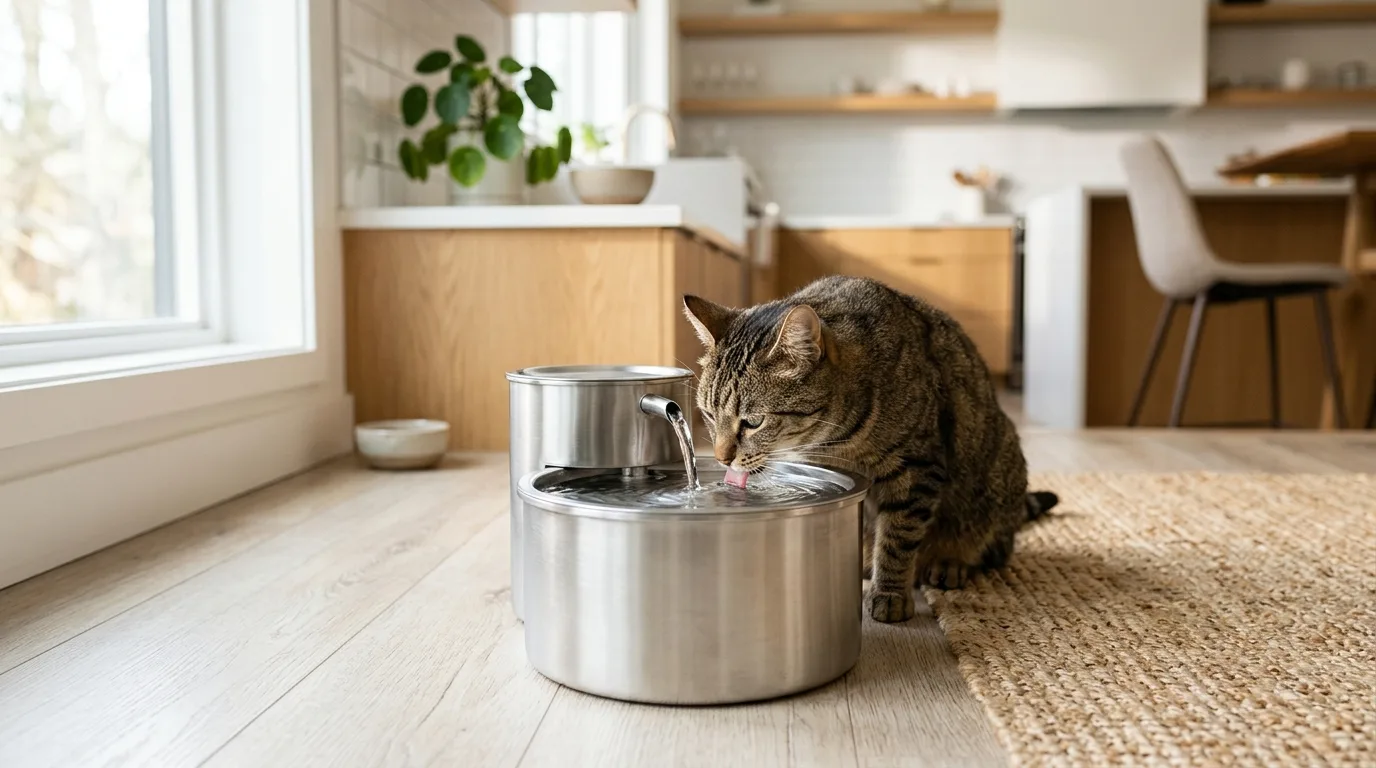
PETKIT Eversweet 3 Pro Review: Stainless Steel Hygiene Joins the PETKIT Ecosystem
1.6L / 56oz
SUS 304 stainless steel
Bluetooth app, Wi-Fi via PETKIT main device
Wireless magnetic induction
Methodology & sources
TestedThis review is backed by a validated long-term test record retained by Sofia Marsh.
Verified on August 8, 2026
Pros
- SUS 304 stainless steel container is non-porous and resists biofilm
- Wireless pump keeps every cord out of the water
- Bluetooth app reports water level, filter status, and modes
- Pairs with a PETKIT main device for full Wi-Fi remote access
Cons
- Bluetooth only unless paired with a PETKIT main device
- 1.6L capacity is smaller than many rivals
- USB wall adapter is not included in the box
Best for
- Cats with feline chin acne or plastic sensitivity
- Owners who already run a PETKIT smart litter box or feeder
- Anyone who wants the most hygienic water path in the category
Spec comparison
| Spec comparison | PETKIT Eversweet 3 Pro Cat Water Fountain | PETLIBRO Dockstream Smart Water Fountain | PetSafe Drinkwell Platinum Pet Fountain |
|---|---|---|---|
| Capacity | 1.6L / 56oz | 2.5L / 84oz | 168 oz / 1.3 gal (~5 L) |
| Container material | SUS 304 stainless steel, BPA-free | — | — |
| Base | ABS plastic, separate from water tank | — | — |
| Connectivity | Bluetooth app; Wi-Fi remote via PETKIT main device | 2.4GHz Wi-Fi app monitoring | — |
| Pump | Wireless magnetic-induction pump, no cord in water | Wireless pump, no external cord | Submersible, low-voltage 12 V, ~5.5 ft cord |
| Noise | Under 25 dB (manufacturer rating) | — | — |
| Filtration | 4-layer filter with activated carbon and ion-exchange resin | 4-layer vertical filter | Replaceable activated-carbon filter plus pre-filter |
| Flow modes | Smart (intermittent), Normal (continuous), Night | Continuous and intermittent | — |
| Power | USB 5V/1A, cable included, wall adapter not included | AC adapter, 5V/1A DC output | — |
| Safety | Anti-dry-burn automatic pump shutoff | — | — |
| Dimensions | 7.7 x 7.7 x 5.8 in, 3.8 lb | — | — |
| Warranty | 12-month limited manufacturer warranty | 24-month warranty | 1-year limited warranty (US) |
| Tray material | — | 304 stainless steel | — |
| Intake tracking | — | PawSense water-consumption logging | — |
| Sensor | — | Radar induction (flow on approach) | — |
| Material safety | — | BPA-free | — |
| Reservoir | — | — | Snap-on rear reservoir, gravity-fed |
| Stream | — | — | Patented free-falling stream, adjustable flow |
| Materials | — | — | BPA-free plastic |
| Cleaning | — | — | Top-rack dishwasher safe (pump hand-wash only) |
| Model | — | — | PWW00-13703 |
Cats are poor drinkers by nature. Descended from desert animals, the species has a weak thirst drive and was built to draw most of its moisture from prey, so a cat eating dry food beside a still bowl often drinks less than it should. Chronic under-hydration is tied to the urinary and kidney problems behind many feline vet visits, and moving, filtered water is the most reliable prompt to drink more. That is the job a fountain exists to do.
The PETKIT Eversweet 3 Pro is the premium-tier entry in PETKIT's fountain line, and it differentiates itself on two grounds. The first is material: the entire water container is SUS 304 stainless steel rather than plastic, which changes the hygiene equation of owning a fountain at all. The second is ecosystem: the fountain talks to the PETKIT app, and for households that already run one of the brand's smart litter boxes, it gains full remote access through a feature no rival fountain offers. A wireless pump that keeps every cord out of the water completes the package.
The stainless steel water path
The headline feature is the container. Where most fountains, including PETKIT's own Solo models, hold water in plastic, the Eversweet 3 Pro uses a SUS 304 food-grade stainless steel tank, the same grade common in human cookware. Stainless steel is non-porous and BPA-free, it does not develop the microscopic scratches plastic accumulates over months of scrubbing, and it resists the biofilm, the slimy bacterial layer, that builds up quickly on plastic surfaces.
That matters beyond general cleanliness. Plastic bowls and fountains are a known contributor to feline chin acne, the black dots and irritation that appear where a cat's chin repeatedly contacts bacteria-harbouring surfaces. AvailPet's review of this model, produced with a consulting feline veterinarian, reports that switching an acne-prone cat from plastic to stainless steel frequently clears the condition within two to four weeks. That is their clinical experience rather than a guarantee, and persistent skin problems always warrant a vet, but the logic, remove the bacteria reservoir and the irritation often follows, is sound.
The steel construction has a side benefit in stability. At 3.8 pounds the fountain is far heavier than plastic rivals, and a cat that bumps or paws at it will not send it sliding across the floor. The trade-off is that a full stainless tank is heavier to lift to the sink.
The wireless pump, with one honest caveat
Like the PETLIBRO Dockstream, the Eversweet 3 Pro uses a wireless pump, driven by magnetic induction from the powered base, so no electrical cable ever enters the water. The whole water-carrying assembly lifts away from the base as one piece, making refilling and washing far simpler than on corded designs. An anti-dry-burn sensor stops the pump automatically when the water runs too low, protecting the motor from damage.
The caveat deserves emphasis because the naming confuses buyers: wireless pump does not mean a cordless fountain. The base still needs mains power over a USB cable rated at 5V/1A, and PETKIT's own listing spells this out with a "NOT cordless" note. The cable is included in the box; the wall adapter is not, so the fountain needs a spare USB adapter or a free USB port to run. Unlike the battery-powered Dockstream, this fountain stays tethered to a socket, which dictates placement.
App control and the PETKIT ecosystem
Out of the box, the fountain connects to the PETKIT app over Bluetooth. From the app an owner can check the water level, see the filter's remaining life, switch between flow modes, and receive maintenance reminders. That is status monitoring and mode control rather than the intake metering the Dockstream's PawSense system offers; this fountain does not log how much a cat drinks, and buyers should be clear on that distinction.
The genuinely unique trick is what PETKIT calls remote interconnection. Pair the fountain with a PETKIT main device and it inherits that device's Wi-Fi connection, upgrading from Bluetooth-range control to full remote access from anywhere. The qualifying devices include the PETKIT PuraMax 2 self-cleaning litter box and the PETKIT Purobot Max Pro 2, both already part of this site's coverage. An owner with one of those boxes at home can check the fountain's water level from the office or from holiday, with no extra hub to buy.
For a household already inside the PETKIT ecosystem this is close to a deciding feature; for everyone else, connectivity stops at Bluetooth range.
Flow modes and noise
Three modes let the fountain match the cat and the household. Normal mode runs the water continuously, suiting cats that prefer a steady stream and owners who want maximum aeration. Smart mode cycles the flow intermittently, refreshing the water on a schedule while reducing pump wear and power draw. A night mode quiets things further during sleeping hours, which pairs naturally with the fountain's strongest acoustic credential: PETKIT rates the pump at under 25 dB, quiet enough for a bedroom.
That figure assumes a healthy pump and adequate water: the gurgling owners complain about across the category almost always traces back to a low water level or a pump overdue for cleaning. The app's water-level alerts and the dry-burn shutoff help, but topping up and pump cleaning remain the owner's job.
Filtration
Water passes through a four-layer filter before recirculating. A mesh layer catches hair, food debris, and grit; coconut-shell activated carbon reduces odours and improves taste; an ion-exchange resin layer captures hardness minerals; and a final fine layer handles smaller impurities. Cleaner-tasting water is not a luxury here, it is the mechanism, since a cat that finds the water appealing drinks more of it.
Filters are consumables, and a neglected one eventually does more harm than good. PETKIT's product page, quoting WIRED's coverage, describes the filter as effective for up to about eight weeks in Smart mode, and the app prompts when a change is due. Replacement filters, and eventually a replacement pump, are a recurring cost of owning any fountain rather than a surprise specific to this one.
Capacity and everyday living
At 1.6 litres, or 56 ounces, the tank is on the small side for the category, below the Dockstream's 2.5 litres and below even PETKIT's own 2-litre Solo 2. PETKIT puts endurance at roughly five to seven days for a single cat; AvailPet's coverage suggests refilling every three to four days for two. For a single-cat home that covers a weekend away comfortably; multi-cat households face a refill rhythm some owners will find tedious, and a larger reservoir becomes the sensible choice. The footprint is compact at 7.7 by 7.7 inches, and the low 5.8-inch height suits kittens and older cats that find taller rims awkward to drink over.
Cleaning and maintenance
The maintenance routine is the standard fountain trio: wash the tank regularly, clean the pump periodically, replace the filter on schedule. The design helps: the stainless tank wipes clean without holding odours or stains, and with no cable on the pump, the whole water path separates from the powered base and goes to the sink as one piece. A fouled pump is the usual cause of noise and weak flow, so a periodic strip-down and rinse keeps things running. The app's reminders help with discipline, but no reminder washes the tank: a grimy fountain is one a fastidious cat will simply refuse, which undoes the point of owning it.
Getting a cat to accept a fountain
Any new fountain needs a patient introduction, and the reliable method is coexistence: set the fountain up near the existing bowl and leave both in place for several days, letting the cat investigate the moving water on its own terms before the old bowl comes away. Placement matters too. Many cats instinctively prefer to drink away from where they eat, so a quiet corner across the room from the food bowl tends to get more visits than a spot beside the feeder. The one constraint is the USB lead: because this fountain is not battery-powered, the ideal spot still needs to be within reach of a socket.
Who should consider it
The strongest case is a cat with feline chin acne or a known plastic sensitivity, where the stainless water path is not a luxury but the point of the purchase. It suits hygiene-focused owners generally, since a non-porous steel container is simply easier to keep genuinely clean than plastic. And it is close to automatic for anyone who already owns a PETKIT PuraMax 2 or PETKIT Purobot Max Pro 2, because remote interconnection turns a Bluetooth gadget into a fully remote one using hardware already in the house. Single-cat and two-cat homes, and anyone placing a fountain near a bedroom, will appreciate the quiet pump and compact footprint.
Who should skip it
Multi-cat households with three or more drinkers will find the 1.6-litre tank demands too frequent refilling and should look at larger reservoirs. Buyers who want native Wi-Fi without buying into a broader ecosystem are better served by the PETLIBRO Dockstream, which connects over 2.4GHz Wi-Fi on its own and adds intake logging this model lacks. Owners who want a cordless, battery-powered fountain should note the tethered USB base. And anyone who simply wants an unpowered bowl with no filters, no pump, and no app will find any fountain, this one included, more device than they need.
Verdict
On its published specifications, the PETKIT Eversweet 3 Pro is a well-judged premium-tier fountain with a clear identity. The SUS 304 stainless steel container is a genuine hygiene upgrade over plastic, non-porous, easy to sanitise, and the right prescription for cats prone to chin acne. The wireless induction pump keeps cords out of the water and lets the whole tank lift away for cleaning, the four-layer filter does the expected work on debris, odour, and hardness, and the manufacturer-rated noise level of under 25 dB makes it one of the quieter options going. The cleverest thing here is remote interconnection: paired with a PETKIT main device, the fountain gains full Wi-Fi remote access at no extra hardware cost.
The limitations are equally clear. Standalone connectivity is Bluetooth only, so remote access depends on owning, or buying, another PETKIT appliance. The 1.6-litre capacity trails most rivals and suits one or two cats rather than a crowd. The fountain is not cordless despite the wireless pump, and the USB wall adapter it needs is not in the box. And the smart features are status monitoring and mode control, not the intake tracking some connected fountains offer. None of these are hidden flaws, but they define the buyer this model fits: a hygiene-conscious, single or two-cat household, ideally one already living inside the PETKIT ecosystem. For that household, the Eversweet 3 Pro makes a strong, specific case for itself.
Editorial summary
Editorial overview of the PETKIT Eversweet 3 Pro based on published manufacturer specifications, the app feature list, and independent review coverage.
Where to buy
Check the merchant for the current price and availability. We may earn a commission.