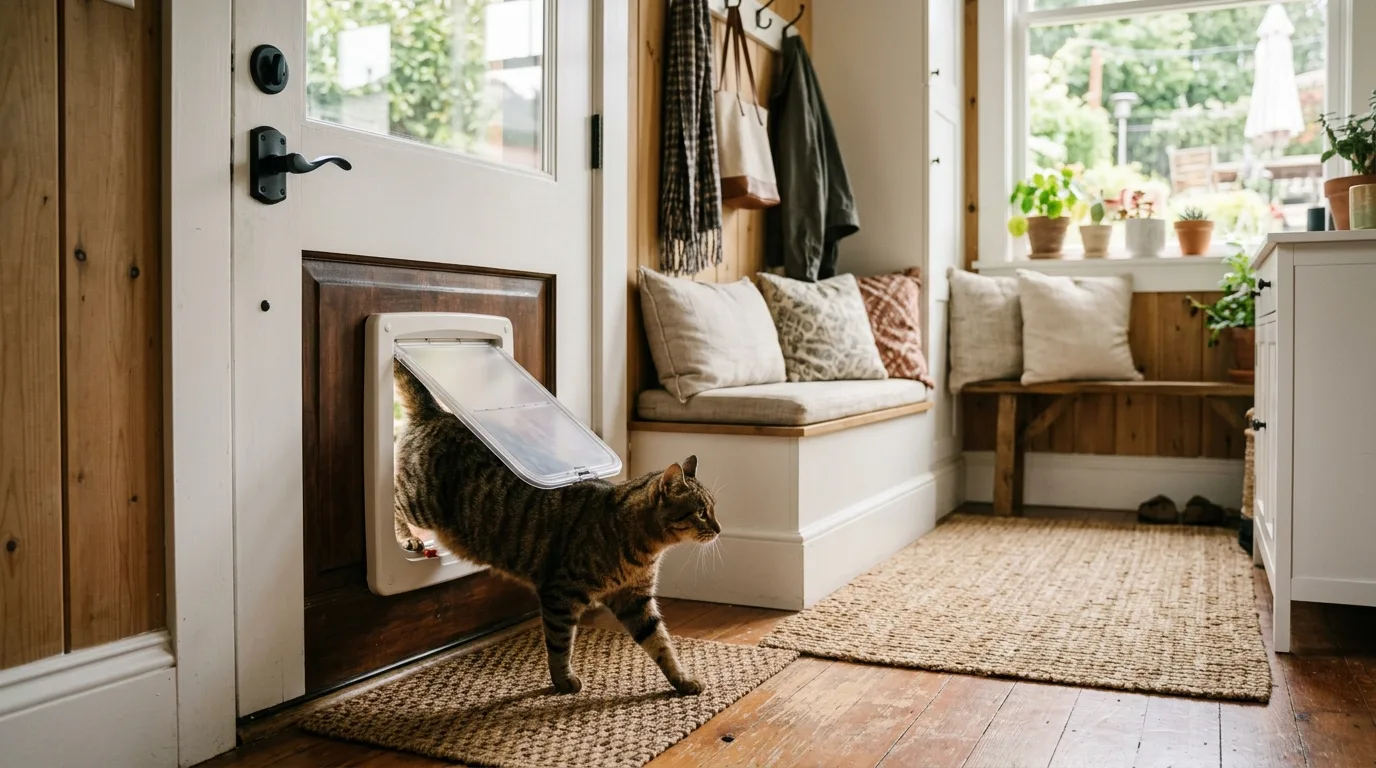
SureFlap Microchip Pet Door Connect Review (2026): App-Controlled Selective Entry
Microchip or RFID tag, up to 32 pets
Remote lock, curfews, notifications
Required, sold separately
7.5 in W x 6 11/16 in H
Methodology & sources
TestedThis review is backed by a validated long-term test record retained by Sofia Marsh.
Verified on August 8, 2026
Pros
- Reads a pet's existing implanted microchip, so no collar is required
- Stores up to 32 pet identities and blocks intruder animals from entering
- App adds remote locking, curfew schedules, and entry/exit notifications
- Long-term activity log surfaces changes in a pet's comings and goings
Cons
- The Sure Petcare Hub is required for the app and is sold separately
- Sized for large cats and small dogs, so bigger dogs will not fit
- Runs on disposable C batteries that are not included in the box
- Needs a microchipped pet or the included RFID collar tag
Best for
- Multi-pet homes where only some animals are allowed outside
- Homes plagued by intruder cats coming through a standard flap
- Owners who want to lock the door remotely or set automatic curfews
- Anyone already running a Sure Petcare Hub with a Connect feeder
The verdict: The SureFlap Microchip Pet Door Connect is the pet door to buy when deciding which animals come in, and knowing when your own animals come and go, matters more than simply giving a pet free passage. It is the app-connected member of Sure Petcare's door line: a flap that reads a pet's existing implanted microchip and opens only for registered animals, paired through the Sure Petcare Hub with an app that can lock it remotely, schedule curfews, and log every arrival and departure. For a home where one pet is allowed out and another is not, or anywhere a neighbor's cat has learned to wander in, it solves two problems with one hole in the door. Be clear on two things before buying: the flap is sized for large cats and small dogs, not bigger animals, and the Hub that links it to the app is sold separately. Best App-Controlled Pet Door.
The problem with a flap that opens for everything
An ordinary cat flap is a small hole in a home's security. Anything small enough to fit through can follow a pet inside: the neighbor's cat helping itself to the food bowl, a stray marking territory, or worse in some areas. Owners of microchip feeders like the SureFeed microchip feeder know the pattern — once the food is guarded, the intruder pressure often moves to the door itself.
A plain flap also offers no control in the other direction. It cannot keep one animal in while letting another out, it cannot lock itself at night, and it cannot answer the question every outdoor-cat owner asks eventually: is the cat actually home? A dumb flap swings both ways for everyone, and remembers nothing.
How the microchip entry works
The Pet Door Connect puts a microchip reader on the exterior side of the flap. It reads the same implanted chip a vet uses for identification — Sure Petcare lists compatibility with all common FDX-A and FDX-B (ISO) microchips, and its website offers a checker where an owner can confirm a specific chip number — and it opens the flap only when a registered animal pushes against it.
Registration happens at the door itself, where the reader learns each pet's chip during setup, and the door stores up to 32 pet identities. A pet without an implant wears the RFID collar tag included in the box instead. Exit is unrestricted for every animal, because the reader sits on the outside only, so no pet can ever be trapped indoors by the lock. That one-way selectivity is the core of the design: entry is by identity, exit is free.
What the app adds when the Hub is connected
Paired with the Sure Petcare Hub and app, the door becomes something a plain microchip flap cannot be: controllable from anywhere. The owner can lock or unlock the door remotely at any time — locking the cat in ahead of a storm, a vet visit, or fireworks night, without being home.
Curfew schedules automate the routine: set the door to lock and unlock at specified times, so the cat can roam by day and stays in overnight without anyone touching the flap. Notifications report each entry and exit as it happens, and the app keeps a long-term activity log, so a shift in a pet's comings and goings — staying out longer, going out less — shows up as a pattern rather than a hunch. App access can be shared with friends or pet sitters under managed permissions.
The Hub requirement, spelled out
This is the caveat to understand before buying, because it decides what the product actually is in a given home. The app features depend on the Sure Petcare Hub, a small unit that plugs into a spare port on the home router and links the door to the internet, and the Hub is sold separately.
One Hub connects up to ten Sure Petcare devices, so it is shared infrastructure rather than a per-product cost. An owner who already has a SureFeed Connect feeder paired in the app already owns the Hub this door needs, and the door simply joins it. Without a Hub, the door still works as a full microchip pet door — selective entry for registered pets, free exit for all — but the remote locking, curfews, notifications, and activity logging stay dark. Some listings bundle the door and Hub together, the cleaner way to buy in for a first-time owner.
Installation: doors, walls, and glass
The door installs like a conventional pet door, and Sure Petcare publishes the cutout dimensions for each mounting type. The flap opening — the smallest area a pet has to pass through — is 7.5 inches wide by 6 11/16 inches high, with a tunnel depth of 2 3/4 inches. A door or wall needs a cutout of 8 1/8 inches wide by 9 3/16 inches high, and the exterior frame doubles as the cutting template.
Glass mounting is possible but more involved: it requires a circular hole, with 300 mm (about 11 13/16 inches) the optimum size and holes up to 320 mm accommodated. Cutting a round hole that size in a pane is typically a glazier's job rather than a weekend project, so glass or window mounting should factor in professional fitting. However it is mounted, the sizing targets large cats and small dogs — a medium or large dog will not fit through an opening this size.
Battery life and daily use
The door runs on four C-cell batteries, which are not included in the box, and Sure Petcare rates a set at up to six months of use. Battery power keeps installation cordless, at the cost of occasional replacements. Sure Petcare backs the door with a three-year warranty.
In daily use the door is passive: once pets are registered and the Hub is linked, it opens for the right animals, refuses the wrong ones, and quietly logs comings and goings, with nothing to program beyond chosen curfews and no subscription to pay.
Where it falls short
The limits follow from the design. The clearest is the Hub: everything that justifies the Connect over the brand's standard Microchip Pet Door requires a separate purchase, and an owner who skips it is left with a capable but ordinary microchip door.
The rest are physical. The flap fits large cats and small dogs only, so homes with bigger dogs need a different category of door entirely. It runs on disposable batteries rather than mains power, and the first set is not included. Glass installation needs a large circular cutout that usually means hiring a glazier. And it sits in the premium tier of pet doors — widely sold below its original launch price, including direct from the manufacturer, but still a considered purchase once the Hub is added for a first-time buyer.
Connect vs the standard Microchip Pet Door
Sure Petcare sells the same idea without the app: the standard Microchip Pet Door reads the same chips, stores the same registered pets, and blocks the same intruders, with no Hub and nothing to connect. For an owner who only wants the neighborhood cats kept out, that model does the entire job for less.
The Connect earns its step up when control and visibility matter: remote locking, timed curfews, entry and exit alerts, and the long-term activity record. It makes the most sense for a household already inside the Sure Petcare ecosystem, where the Hub is a sunk cost and the door slots into the same app as the feeders. The brand also makes cat-sized door variants on the same microchip system for smaller cats.
Who should buy it
Buy it for a multi-pet home where access needs to differ by animal — one pet allowed out, another kept in — or anywhere intruder animals have learned to treat a standard flap as an open invitation. It is the right choice for owners who want to lock the door remotely, run an overnight curfew automatically, or simply know whether the cat is home, and it is the obvious next device for anyone who already runs a Sure Petcare Hub with a Connect feeder.
Who should skip it
Skip it if the separately sold Hub is a dealbreaker, because without it the Connect is a plain microchip door and the standard model does that job for less. Pass, too, for a medium or large dog, which simply will not fit the opening, and for anyone who wants only basic selective entry with no interest in app control, where the non-Connect Microchip Pet Door is the cleaner buy.
FAQ
Does the SureFlap Microchip Pet Door Connect work without the Hub? Yes as a pet door, no as a smart device. Without the Hub it still reads microchips, opens only for registered pets, and lets any animal exit freely. The app control, curfew schedules, notifications, and activity logging all require the separately sold Hub.
Does your pet need a microchip? Not necessarily. The door reads common implanted microchips — FDX-A and FDX-B (ISO) types, per Sure Petcare's online compatibility checker — and the box includes an RFID collar tag for a pet without an implant.
How many pets can it remember? Up to 32 registered pet identities, each recognized by its own microchip or collar tag.
Will it fit a large dog? No. The flap opening is 7.5 inches wide by 6 11/16 inches high, and Sure Petcare designs the door for large cats and small dogs. Medium and large dogs need a bigger door category.
Can it be installed in glass? Yes, with a circular hole — 300 mm (about 11 13/16 inches) is the optimum size, and holes up to 320 mm are supported. A cutout that size in glass is normally a job for a professional glazier.
Bottom line
The SureFlap Microchip Pet Door Connect takes the most useful idea in pet doors — a flap that opens only for a pet's own microchip — and makes it controllable from a phone. Selective entry keeps intruder animals out, free exit keeps every pet safe, and paired with the separately sold Hub the app adds remote locking, automatic curfews, entry and exit alerts, and a long-term record of each animal's comings and goings. Go in clear that the flap fits large cats and small dogs and that the smart features depend on the Hub, and for a home that wants control over who comes and goes it is the most complete microchip door in the category. See it on Amazon to check the current price.
Editorial summary
Editorial overview of the SureFlap Microchip Pet Door Connect based on published manufacturer specifications, covering microchip-selective entry, Hub-connected app control, and installation fit for large cats and small dogs.
Where to buy
Check the merchant for the current price and availability. We may earn a commission.