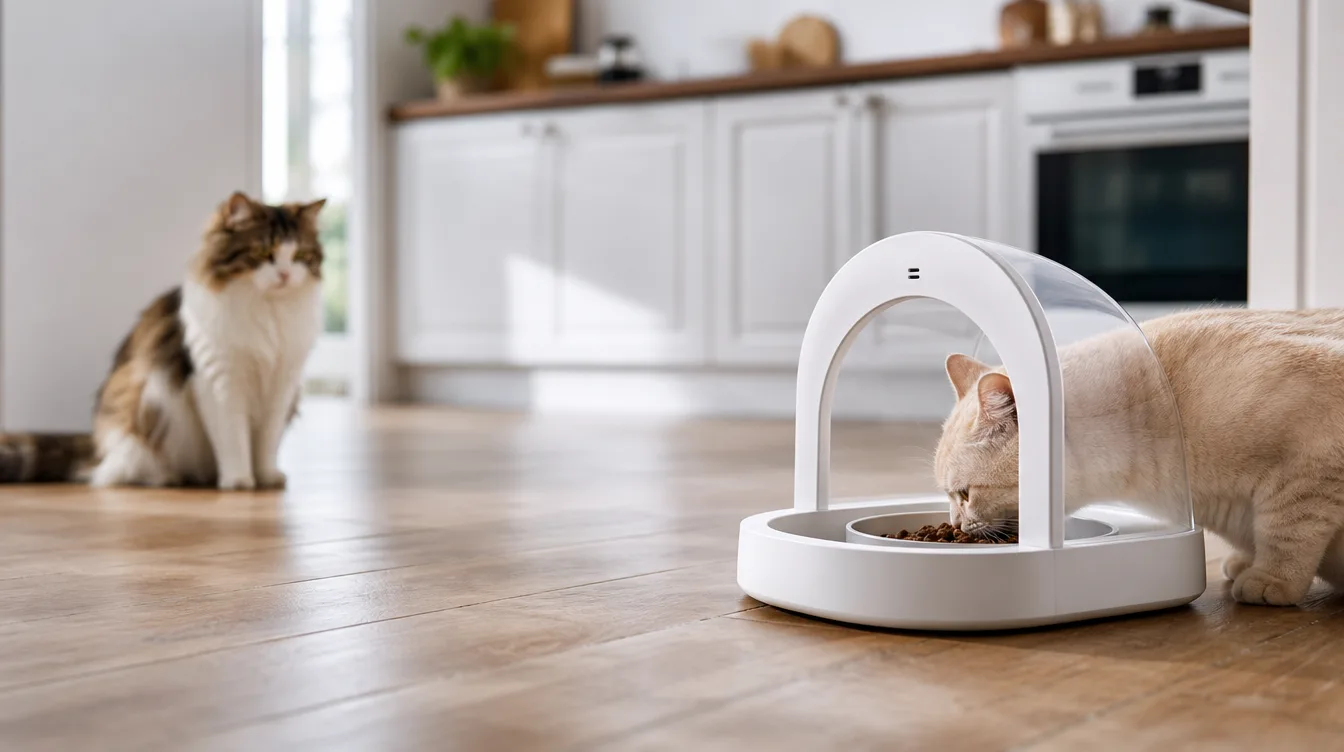
SureFeed Microchip Pet Feeder Review (2026): The Food-Theft Solver
400 ml (13.5 fl oz)
Microchip or RFID tag
Up to 32
4 C batteries, about 6 months
Methodology & sources
TestedThis review is backed by a validated long-term test record retained by Sofia Marsh.
Verified on August 8, 2026
Pros
- Opens only for the registered pet's microchip, ending food theft
- Works with an existing implanted microchip or the included collar tag
- Sealed lid keeps wet food fresh and blocks flies
- No hub, WiFi, or subscription needed to work
Cons
- Not a scheduled portion feeder, so it will not dispense meals on a timer
- Runs on disposable C batteries rather than mains power
- Needs a microchipped pet or willingness to use the collar tag
- Timid pets can need the training mode and some patience
Best for
- Multi-pet homes where one animal steals another's food
- Cats or dogs on prescription, weight-control, or medicated diets
- Owners of a slow grazer who needs food left down without a thief
Spec comparison
| Spec comparison | SureFeed Microchip Pet Feeder | PETLIBRO Automatic Feeder with Camera | PETLIBRO Granary WiFi Automatic Feeder |
|---|---|---|---|
| Bowl capacity | 400 ml (13.5 fl oz), fits two wet-food pouches | — | — |
| Selective access | Implanted microchip or RFID collar tag | — | — |
| Pets stored | Up to 32 | — | — |
| Microchip types | FDX-A, FDX-B, and Avid Secure | — | — |
| Power | 4 C batteries, about 6 months | Adapter with battery backup | Adapter with battery backup |
| Lid delay | Adjustable, roughly 1 to 3 seconds | — | — |
| Food | Wet or dry | — | — |
| Included | Full bowl, split bowl, mat | — | — |
| Connectivity | None — offline device, no app | 5G Wi-Fi (2.4GHz) | 5G Wi-Fi (2.4GHz) |
| App required? | No | Yes for scheduling and camera; saved schedule still runs if Wi-Fi drops | Yes for scheduling; saved schedule still runs if Wi-Fi drops |
| Warranty | 3-year warranty | 24-month warranty | 24-month warranty |
| Dimensions | 9 x 12 5/8 x 7 7/8 in (W x D x H) | 13 x 7.5 x 7.5 in (34 x 19 x 19 cm) | 13.4 x 7.5 x 7.5 in (34 x 19 x 19 cm) |
| Camera | — | 1080p HD with night vision | — |
| Audio | — | Two-way talk | — |
| Scheduling | — | Programmable daily meals | Up to 10 meals per day |
| Alerts | — | Low-food, motion, and sound | — |
| Suited for | — | Up to two cats | — |
| Freshness | — | Sealed hopper with desiccant compartment | Desiccant bag compartment in lid |
| Capacity | — | 5L hopper | — |
| Hopper capacity | — | — | 5L |
| Portion size | — | — | 1 to 50 portions per meal |
| Sensors | — | — | Low-food sensor |
| Voice | — | — | 10-second meal-call recorder |
| Bowl | — | — | Detachable, dishwasher-safe |
The verdict: The SureFeed Microchip Pet Feeder solves one specific, maddening problem better than anything else: in a multi-pet home, it stops one animal eating another's food. A sealed lid stays shut until the registered pet's microchip is detected under the hood, then opens for that pet alone and closes again seconds after they leave. It is the go-to answer for households where a cat is on a prescription or weight-control diet, or where a fast eater bullies a slow grazer. Just be clear about what it is not: this is a selective bowl, not a timed portion feeder, and it runs on batteries rather than a plug. For the food-theft problem, nothing on Amazon does it more cleanly. Best Microchip Feeder.
The multi-cat food-stealing problem
Anyone with more than one pet knows the scene. One cat is a delicate grazer who eats a little and wanders off. The other inhales its own bowl and then strolls over to finish the first cat's lunch. Add a prescription diet, a weight-management plan, or a medicated food into the mix and the stakes rise from annoying to genuinely bad for the animal's health.
Ordinary bowls cannot fix this, and neither can a standard scheduled feeder, which will happily dispense a portion that the wrong pet then steals. The SureFeed takes a different approach entirely. Rather than controlling when food appears, it controls who is allowed to reach it. That single idea is why the site's existing automatic feeders and this device solve different problems, and why a food-theft home needs this one.
How the microchip lid actually works
The SureFeed is built around a motorised lid over a bowl. By default that lid stays closed, sealing the food away from every animal in the house. Each pet you want to grant access to is registered to the feeder, either through the microchip already implanted by a vet or through an RFID collar tag included in the box.
When a registered pet lowers its head under the feeder's hood, the reader detects the chip and the lid slides open, giving that pet clear access to the bowl. When the pet lifts its head and walks away, the lid closes again after a short delay you can set to roughly one, two, or three seconds. Any unregistered animal that approaches simply finds a closed lid. The feeder stores up to 32 pet identities, so it scales from a two-cat flat to a busy multi-pet household, and it is compatible with the common microchip formats, including FDX-A, FDX-B, and Avid Secure chips.
What it is not: a portion feeder
This is the single most important thing to understand before buying, and it is where disappointed reviews come from. The SureFeed is not an automatic portion feeder. It does not hold a hopper of kibble, it does not dispense meals on a schedule, and it has no app or timer. It is a guarded bowl.
You still put food in the bowl yourself, exactly as you would with any dish. What the SureFeed adds is a lock that only the right pet can open. If your goal is to leave food down for a grazer without a thief getting it, or to protect a prescription diet, that is precisely what you want. If your goal is timed portions while you are at work, you want a programmable dispenser instead, such as the ones covered in the Petlibro Granary feeder review. The two devices are often confused and they are not interchangeable.
Setup, microchips, and the collar tag
Setup is refreshingly low-tech. There is no WiFi to join and no account to create. You put in the batteries, hold the training button, and let each pet's chip register as they eat. If a pet is not microchipped, the included RFID collar tag does the same job.
Because some animals are wary of a moving lid, Sure Petcare builds in a training mode that lets the lid stay open at first and then close in gradual stages, so a nervous cat learns the bowl is safe before the mechanism starts moving fully. It takes patience with a timid pet, but the staged approach is well judged.
The bowl holds 400 ml, enough for a generous portion of dry food or two pouches of wet, and a sealed neoprene ring around the lid keeps wet food fresher for longer while blocking flies. The box includes both a full bowl and a split bowl, so you can serve wet and dry side by side or separate two textures.
Battery life and daily use
The feeder runs on four C batteries rather than mains power, which keeps it cordless and placeable anywhere but does mean occasional battery changes. Sure Petcare rates it at around six months per set, and a low-battery indicator warns you before it dies. Usefully, the feeder remembers every registered pet even with the batteries removed, so a swap does not mean starting the setup over.
In daily use the appeal is how little it asks of you. There is no schedule to program, no app to check, and no subscription. Once each pet is registered, the feeder simply does its one job, opening for the right animal and staying shut for the rest.
Where it falls short
The limitations follow directly from the design. It is not a portion feeder, so anyone hoping for scheduled meals will be frustrated. It runs on disposable batteries rather than a plug, which is a small ongoing cost and chore. It requires either a microchipped pet or the willingness to use the collar tag, so a household set against both is out.
There is also a practical multi-thief wrinkle: one SureFeed protects one bowl for the pets registered to it. If you have two grazers who each need their own protected food and who would raid each other, you are looking at two units. And a genuinely timid animal can need real patience with the training mode before it will eat confidently under a lid that moves.
Who should buy it
The SureFeed is the right tool for a very specific and very common problem. Buy it if you have a multi-pet home where one animal steals another's food, if a cat or dog is on a prescription, weight-control, or medicated diet that others must not eat, or if you have a slow grazer whose food needs to stay down all day without a thief cleaning it out. For those homes it is close to essential, and it is a common recommendation from vets for exactly these diet-management situations.
Who should skip it
Skip it if you have a single pet and simply want timed portions while you are away, since a programmable feeder does that job and this does not. Pass, too, if you want app control, scheduling, or mains power, or if you are unwilling to microchip your pet or fit the RFID collar tag. In those cases a conventional automatic feeder is the better buy.
FAQ
Is the SureFeed a portion or scheduled feeder? No. It is a selective bowl, not a timed dispenser. You fill the bowl yourself; the feeder only controls which pet can open the lid. For scheduled portions, choose a programmable feeder instead.
Does your pet need a microchip? Not necessarily. It reads an implanted vet microchip if your pet has one, and the box includes an RFID collar tag for pets that do not.
How many pets can it recognise? Up to 32 registered microchips or collar tags, so it works from a two-pet home up to a large multi-pet household.
Does it need WiFi or a subscription? No. There is no hub, no app requirement, and no monthly fee. It runs entirely on its own batteries.
How long do the batteries last? Sure Petcare rates the four C batteries at about six months, with a low-battery warning before they run out. Registered pets are remembered even when the batteries are removed.
Bottom line
The SureFeed Microchip Pet Feeder does one thing, and it does it better than any workaround: it stops the wrong pet eating the right pet's food. A sealed, microchip-triggered lid means a grazer's meal, or a prescription diet, stays safe from a thief without any schedules, apps, or subscriptions to manage. Go in understanding it is a guarded bowl rather than a timed feeder, and for a multi-pet food-theft home it is the cleanest fix available. See it on Amazon to check the current price.
Editorial summary
The SureFeed Microchip Pet Feeder is a selective bowl that opens only for the right pet's microchip, ending food theft in multi-pet homes. Specs, setup, and who it suits.
Where to buy
Check the merchant for the current price and availability. We may earn a commission.